W Marina Place

This street, established in 1991 as part of the development of the Elliott Bay Marina at the southern foot of Magnolia Bluff, runs ⅖ of a mile west from 23rd Avenue W to just shy of the 30th Avenue W street end beach.

While the origin of its name may not be interesting, the story of its establishment is a bit more so:

  • The marina itself began the permitting process in 1983, but lawsuits delayed its creation for nearly a decade. The Muckleshoot Indian Tribe and Suquamish Tribe sued to block its construction on the basis that “construction of the Marina would eliminate a portion of one of their usual and accustomed fishing areas in Elliott Bay and thus would interfere with their treaty right to fish at the Marina site.” Homeowners on the bluff above intervened on the side of the developers, as “the area has had numerous major landslides that have left several homes at the crest of the bluff at risk and have repeatedly caused breaks in a trunk sewer line located at the base of the bluff.… The Marina construction includes the placement of 500,000 cubic yards of fill at the toe of the bluff, which would stabilize the area.” Eventually, a settlement was reached, which “calls for ongoing fisheries-related expenses paid to the tribe, which will be funded by a percentage of the moorage income.… [the] ‘Indian Treaty Surcharge.’”
  • I believe this was the last major fill operation within Seattle city limits. Such a development would be all but unthinkable today.
  • The marina was built on tidelands where W Lee Street and Puget Avenue W were platted but never built. They were vacated and W Marina Place was established. When it came to naming the access road, the developers originally proposed W Marina Boulevard, contending that as the road fell between the W Oakes Street right-of-way and the former W Lee Street right-of-way, it wasn’t a violation of the city’s principle of maintaining street grid names as much as possible. This was initially rejected by the city, which preferred W Lee Street, but after further discussion, W Marina Place was settled on. An interesting point the developers made was that as W Lee Street had never physically existed in Magnolia, though it had been platted there, calling the access road W Lee Street could actually be confusing, as “people familiar with Seattle streets know that there is no W Lee Street on Magnolia. Rather, they know W Lee Street as being on Queen Anne Hill.” Still, though, I have to believe they were more interested in their own vanity — Marina Boulevard? — than any particular concern for folks’ ability to navigate.
  • For some reason, the public street ends just feet from the 30th Avenue W street end beach. I’m not entirely sure why that is; I don’t think the marina is opposed to public access to the beach; otherwise, they wouldn’t be in favor of the Magnolia Trail project, which would connect W Marina Place to W Galer Street, 32nd Avenue W, and thence to Magnolia Village.
Aerial photograph of Elliott Bay Marina area in the 1930sAerial photograph of Elliott Bay Marina area, present day
Elliott Bay Marina site, 1930s and today

University Way NE

This street runs 1¼ mile from NE Pacific Street in the south to NE Ravenna Boulevard and Cowen Park in the north. Until 2001, it was a block longer, starting farther south at NE Boat Street, but that portion was vacated as part of the development of the University of Washington campus.

Originally Columbus Avenue and then 14th Avenue NE, it was renamed University Way in 1920 after the University of Washington, which had moved to the neighborhood from its original home downtown in 1895. As local historian Paul Dorpat explains in this HistoryLink essay,

[In 1919] the University Commercial Club… ran [a contest] to rename 14th Avenue…. Club member Arthur Quigley’s “University Way” won the street name contest easily. To deflect any charges that the contest was fixed, Quigley donated the prize money to charity.

Even though it’s been a “way” for 101 years now, to locals University Way has always been, and always will be, “The Ave.” And that in itself will always cause some confusion, as this street sign demonstrates.

Even the city gets street names wrong sometimes. Photograph by Benjamin Lukoff, May 23, 2008. Copyright © 2008 Benjamin Lukoff. All rights reserved.

E Conover Court

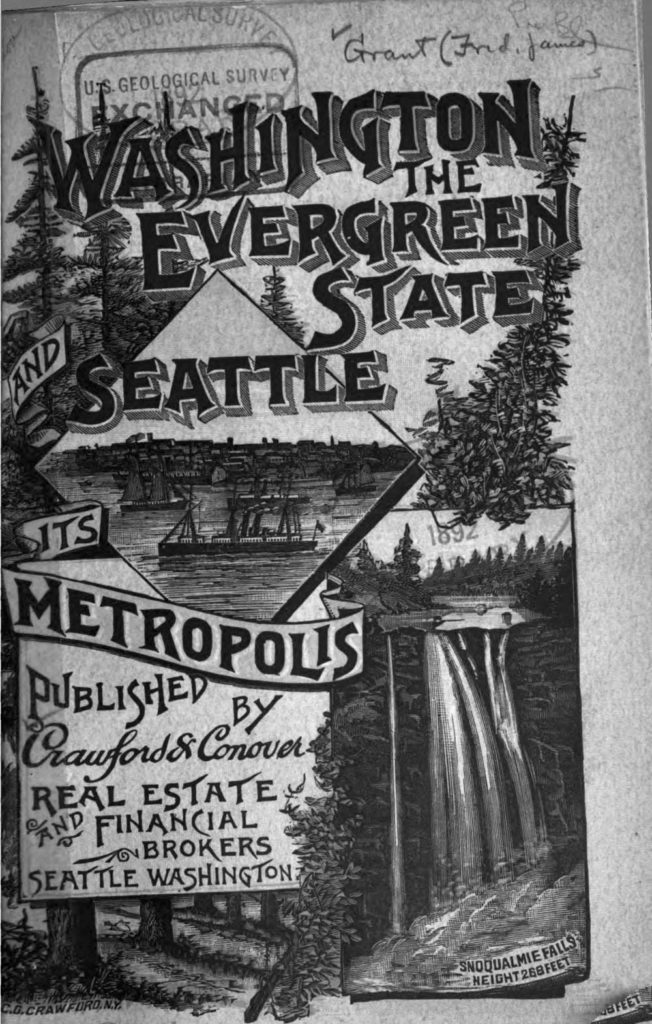
This cul-de-sac, which runs about 300 feet from the end of 35th Avenue just south of E James Street, was named by journalist and real estate developer C.T. (Charles Tallmadge) Conover after himself. Unlike many developers, he didn’t do this when his plat (“Conover Park”) was first filed in 1907, but rather 15 years later when a new street was established in the subdivision. Perhaps his most lasting achievement was Washington’s nickname, “The Evergreen State,” which he coined in 1890.

CT Conover in 1893
C.T. Conover in 1893
Cover of Washington the Evergreen State and Seattle Its Metropolis brochure
Cover of brochure “Washington the Evergreen State and Seattle Its Metropolis”

Portage Bay Place E

This street, which runs ³⁄₁₀ of a mile from Fuhrman Avenue E to E Allison Street, was established as an alley in 1890 as part of the Denny–Fuhrman Addition to the City of Seattle, but only received a name in 1936. It was named for Portage Bay, the eastern arm of Lake Union, which it parallels. Portage Bay was in turn named for the portage from Union Bay (part of Lake Washington) to Lake Union over the Montlake Isthmus, which is today the Montlake Cut of the Lake Washington Ship Canal.

Sign at corner of Fuhrman Avenue E, Eastlake Avenue E, and Portage Bay Place E, August 24, 2009
Sign at corner of Fuhrman Avenue E, Eastlake Avenue E, and Portage Bay Place E, August 24, 2009. Portage By Pl is an error; it should read Portage Bay Pl E, as it’s [[Portage Bay] [Place]], not [[Portage] [Bay Place]]. The original Red Robin restaurant was founded at this intersection in 1940. It has since been demolished, but I’ve seen imagery of this sign — including the error — on the walls of other Red Robin locations. Photograph by Benjamin Lukoff. Copyright © 2009 Benjamin Lukoff. All rights reserved.

Island Drive S

There are only a handful of islands within Seattle city limits, and of them just one — Harbor Island — is large enough to have streets on it. But Island Drive S isn’t on Harbor Island — rather, it’s along the shore of Lake Washington, 5½ miles to the southeast. What gives?

As it turns out, Island Drive once was on an island — Pritchard Island. Known as tleelh-chus (‘little island’) by the Duwamish tribe, it was bought in 1900 by Alfred J. Pritchard (grandfather of Joel Pritchard, who was a congressman from Washington state in the 1970s and 1980s and its lieutenant governor in the 1980s and 1990s). In 1916, Lake Washington was lowered by 9 feet as part of the construction of the Lake Washington Ship Canal, and Pritchard’s island became part of the mainland.

It’s still known as Pritchard Island, though. Today, Pritchard Island Beach, Rainier Beach Urban Farm and Wetlands, and Be’er Sheva Park separate the island from the mainland.

Occidental Avenue S

Occidental Avenue S, which begins at Yesler Way in Pioneer Square, is one of those Seattle streets whose names extend into the suburbs. It makes its southernmost appearance at S 197th Street in Des Moines.

It received its name in 1895 as part of the Great Renaming — it had originally been S Second Street. It once had a partner, Oriental Avenue, to the east (originally S Fourth Street), which is today 3rd Avenue S. “Oriental,” of course, means “Eastern,” as “Occidental” means “Western.” (I haven’t been able to determine just when Oriental Avenue became 3rd, but it was last mentioned in The Seattle Times on October 17, 1920.)

And why this particular pairing? The Occidental Hotel, which once overlooked the beginning of Occidental Avenue, is almost certainly the reason, but it’s not spelled out in the ordinance.

W Armory Way

This Interbay street, established in 1910 as Lawton Way, runs ¼ mile northwest from 15th Avenue W to the BNSF Railway’s Balmer Yard. Its right-of-way runs about 800 feet beyond that, across the railroad tracks, to 20th Avenue W, as it was once the location of a bridge to Magnolia.

W Lawton Way was changed to W Armory Way in 1973, presumably in anticipation of the construction in 1974 of an armory for the Washington Army National Guard. Will its name be changed again once the National Guard moves — or if it becomes the location of a new Magnolia Bridge?

(Another Armory Way near Pike Place Market existed on paper for many years — from 1936 to 2019 — but was never built. Something similar is currently under construction.)

S Addition Street

This Industrial District street — a mere 80 feet long — runs from Airport Way S east to the Interstate 5 right-of-way. It may very well be the shortest street in Seattle (I’d love to hear about other candidates).

Sign at corner of S Addition Street and Airport Way S, January 30, 2011
S Addition Street sign, January 30, 2011. Photograph by Benjamin Lukoff. Copyright © 2011 Benjamin Lukoff. All rights reserved.

As explained in SW Seattle Street, the plat of Judkin’s Addition to the Town of Seattle was filed in 1869. From north to south, the east–west streets are named Norman, B, Judkins, Addition, Town, and Seattle. (Did they really think B Street would last, I wonder?)

Of these, Norman, Judkins, Addition, and Seattle Streets remain, though Addition is the only one still in its original location. (SW Seattle Street now only exists for a few blocks in West Seattle, and S Norman and S Judkins Streets only east of Interstate 5.)

Nickerson Street

This Queen Anne street runs 1½ miles from the meeting of 4th, Dexter, and Westlake Avenues N in the east (at the south end of the Fremont Bridge) to the 15th Avenue W interchange in the west. Some businesses in Fishermen’s Terminal have W Nickerson Street addresses, such as Chinook’s at 1900, but these few blocks of Nickerson are Port of Seattle roads that cannot be accessed directly from the public street.

Nickerson Street was named by Alfred A. Nickerson and Elmyra Nickerson, husband and wife, in their plat of Ross 2nd Addition to the City of Seattle in 1888.

Canterbury Lane E

This stub of a street in Madison Park serves mostly as a driveway to the Canterbury Shores Condominiums, although it is public right-of-way. It appears to have been dedicated to the public in 1965, and its name was changed from 40th Avenue E the next year.

My assumption is the street was named for the condominiums, and that the condominiums were named for the Canterbury subdivision to the south, which was laid out in 1951. According to Shaping Seattle Architecture: A Historical Guide to the Architects, John L. Scott’s Canterbury Land Company purchased the land in 1938. (My further assumption is that the subdivision was named for Canterbury, England.)

Webster Point Road NE

This very short street in the Laurelhurst neighborhod — just over 200 feet long — was created in 1962 as part of the Webster Point plat. Why it’s a road rather than a place, lane, or court, I’m not sure — roads in Seattle (of which there aren’t many) are usually longer, such as Windermere Road NE, Holman Road NW, and Military Road S. It has the distinction of the lowest-numbered address on a north–south street north of the Lake Washington Ship Canal, as far as I am aware — 3000.

The plat and road are named for Webster Point, at the very southern tip of the Laurelhurst peninsula, which itself was named for Henry A. Webster, who once owned the land. This Webster appears to have been the Indian agent for the Makah tribe at Neah Bay on the Olympic Peninsula.

University View Place NE

This short street, which runs from NE 50th Street just south of Calvary Cemetery to NE 45th Place, is named for its view of the University of Washington campus to the southwest. It was laid out in 1907 as part of the Exposition Heights addition, which was named after the upcoming Alaska–Yukon–Pacific Exposition on the UW campus.

Alaska–Yukon–Pacific Exposition Seattle 1909

sluʔwiɫ

I end my piece on Lushootseed-language place names in Seattle, “Native names abide,” thus:

…Let Carkeek remain Carkeek, but know that it was once and is still kʷaatəb, as Montlake is still stəx̌ʷugʷił, the Locks, which lowered x̌ačuʔ and x̌áx̌əʔčuʔ, still xʷiwálqʷ, and University Village still sluʔwił village, and celebrate that wǝɫǝbʔaltxʷ now sits where Whitman and Stevens meet.

wǝɫǝbʔaltxʷ – Intellectual House is “a longhouse-style facility on the [University of Washington] Seattle campus [that] provides a multi-service learning and gathering space for American Indian and Alaska Native students, faculty and staff, as well as others from various cultures and communities to come together in a welcoming environment to share knowledge.” Its location at the corner of Stevens Way and Whitman Court is significant in that almost all campus roads are named for Washington counties, and these two counties were named after Isaac Stevens and Marcus and Narcissa Whitman:

  • As noted in “Should Seattle rename its streets?” Stevens, governor of Washington Territory, “forced Native American tribes to cede their lands to the federal government.… He also pardoned himself for contempt charges relating to unjust declaration of martial law during the Yakima War, and insisted on the capture of the subsequently executed Chief Leschi of the Nisqually Tribe, even though at that point he had ceased fighting and fled the area.
  • The Whitmans’ story is more complex. The missionary couple were among 13 whites killed by a group of Cayuse Indians in what has become known as the Whitman massacre. A measles epidemic in the mission settlement and a nearby Cayuse village produced a death rate far higher among the Cayuse; Marcus Whitman, who was a also a physician and tried to treat the Cayuse as well as the whites, was accused of poisoning tribe members: “the fact that nearly all of his white patients recovered while his Indian patients died convinced some Cayuses that he was deliberately poisoning Indians in order to give their land to white setters.” Even though this is unlikely, the fact remains that they were missionaries and colonizers, and there have been calls to replace the statue of Marcus that stands in the National Statuary hall.

Now the University of Washington has renamed Whitman Court sluʔwiɫ, after a village that once stood where University Village is today. (sluʔwiɫ means ‘Little Canoe Channel’ in the Lushootseed language.)

Street sign reading sluʔwiɫ on University of Washington campus
sluʔwiɫ street sign at corner of Stevens Way, with Padelford Hall in the distance, February 2021. Photograph by Benjamin Lukoff. Copyright © 2021 Benjamin Lukoff. All rights reserved.

The UW Board of Regents made this change in May 2018, but the sign only recently made its appearance. I asked the writer of the University of Washington Magazine piece on the name change, Hannelore Sudermann, if she knew whether “the renaming was official — that Whitman Court no longer exists and the street’s name is now sluʔwiɫ – or if it was honorary and the street is still officially Whitman Court,” and she pointed me to the meeting minutes, which read, in part: 

The Board of Regents chooses to honor the Coast Salish peoples of the land on which the University of Washington sits, and indigenous peoples across the State, by renaming Whitman Court sluʔwił.… In the Lushootseed language of the Coast Salish peoples, sluʔwił is the name for the village site closest to the campus, and means ‘Little Canoe Channel.’… It is the Board’s intention to recognize the native place-names of the region and thereby to enrich the historical context of the campus. The Board feels that this naming action is particularly appropriate, given the proximity of Whitman Court to wǝɫǝbʔaltxʷ, meaning ‘Intellectual House,’ a multi-service learning and gathering space for American Indian and Alaska Native students, faculty, and staff.

Even though an earlier part of the minutes reads “Regent Rice moved, Regent Ayer seconded, and the Board of Regents approved the honorific renaming of Whitman Court sluʔwił” (italics mine), given the excerpt above and the presence of the sign without any reference to Whitman Court, my interpretation is that honorific here means “in honor of,” in contrast to honorary meaning “symbolic.” 

Street sign on the University of Washington campus reading Little Canoe Channel NE / sluʔwit; ‘t’ appears instead of the correct ‘ɫ’. sluʔwiɫ means ‘little canoe channel’ in Lushootseed. October 27, 2021
New street sign, reading Little Canoe Channel NE / sluʔwit; ‘t’ appears instead of the correct ‘ɫ’. Photograph by Leslie Holmes, October 27, 2021. Copyright © 2021 Leslie Holmes. All rights reserved.

Update as of February 16, 2023: I recently noticed that sluʔwiɫ is appearing on maps (UW, OpenStreetMap) as sluʔwiɫ (Little Canoe Channel NE). Per the UW’s page on McMahon Hall, “Whitman Court NE has been renamed Sluʔwił (Little Canoe Channel NE). Although street signs have changed, you may hear the street referred to by both names as the name change awaits formal state recognition. The name change acknowledges the Duwamish Peoples who continue to fight for federal recognition as a tribe, and who lived and engaged in potlaches, gift-giving festivals of sharing and trading, in the area, until the land was colonized by white settlers.” I will try to find out when and how formal state recognition will come.

Eagle Street

This 600-foot-long street, which runs from Western to 2nd Avenues a block south of Bay Street, was given that name by William Nathaniel Bell in 1881. In his plat, the large lot between Bay (then Grant) and Lake (now Broad) Streets west of Western Avenue (then West Street) was shown as occupied by the Eagle Manufacturing Co. On this 1884 Sanborn map, though, “Seattle Barrel M’f’y” appears instead. This historic survey says that the Seattle Barrel Manufacturing Company opened in 1880, but was located between Bell and Wall Streets, farther south.

At any rate, it would seem that Eagle Street was named after this Eagle Manufacturing Co., of which I could find no further trace; and that neither Eagle nor Seattle Barrel was there 30 years later, when the 1912 Baist atlas was produced, showing the land to be occupied by Union Oil Company of California (later known as Unocal).

Unocal — which, according to Historylink, had begun using the lot in 1910 — would continue to use it as a fuel depot and marketing terminal until 1975. Cleanup of the contaminated ground began in the 1980s, and the Seattle Art Museum purchased the site in 1999 with help from the Trust for Public Land. In 2007, the Olympic Sculpture Park opened, completing the area’s transformation from open space to industrial area to open space once again.

(Local historian Paul Dorpat points out that the cove that once existed here could be [though never was] called “Eagle Cove” — both for Eagle Street and for the fact that Alexander Calder’s Eagle sculpture now makes its home in the lower half of the park.)

Alexander Calder‘s sculpture ”Eagle”

Bay Street

This street, which runs for a little over a tenth of a mile from Elliott to 1st Avenues, was originally named Grant Street by William Nathaniel Bell in 1881. 14 years later, it was one of the many streets caught up in the Great Renaming of 1895. Per ordinance 4044, it was “ordained… that the name of Grant Street from Elliott Bay to Depot Street, be and the same are hereby changed to Bay Street.” I can’t imagine it took its name from anywhere other than Elliott Bay.

Dilling Way

This street, which runs a mere 200 feet from 4th Avenue to Yesler Way in front of City Hall Park, is named for George W. Dilling, who was mayor of Seattle from 1911 to 1912.

In 1911, Mayor Dilling took an empty lot that until two years earlier had been the location of the Katzenjammer Castle, Seattle’s second city hall, and converted it into what is now known as City Hall Park — originally named Dilling Park in his honor. In 1916, the municipal offices moved once again, to the newly constructed King County Courthouse, then known as the City–County Building, across the Jefferson Street right-of-way from the park. They remained there until 1962, but the park retains the “City Hall” name.

In a letter dated March 29, 1937 from A.C. Van Soelen, corporation counsel for the city, to the Board of Public Works, regarding the ability of the city to restrict parking on Dilling Way, he writes that “Dilling Way apparently never was established or named by ordinance or other action of the City Council and was opened up or paved in 1915 or 1916, presumably in lieu of Jefferson Street which was closed between Third and Fourth Avenue though never formally vacated,” and suggests that the city council “affirmatively declare its policy” regarding the street by passing an ordinance. Such an ordinance was passed shortly thereafter, making the name of Dilling Way official. (Interestingly, that ordinance refers to the street as a “private way,” but the county’s quarter section map shows it as a public road. That same map shows that the walkway in front of the courthouse is still, technically, Jefferson Street.)

E Interlaken Boulevard

The establishment of E Interlaken Boulevard — the first of Seattle’s Olmsted parks and boulevards we’re covering — was first proposed, according to Seattle parks historian Don Sherwood, in 1903 as Volunteer Hill Parkway. Two years later, the current name was adopted. There is speculation, but no documentation, that it was named for the Swiss resort town of that name. Ask a Seattleite how to pronounce “Interlaken” and you may hear either lake or lock, the latter being more common according to an informal Twitter poll I ran (but the former being the one I grew up with).

Text of a Twitter poll by me, reading "Seattleites! How do you pronounce “Interlaken,” as in Interlaken Drive, Interlaken Boulevard, Interlaken Place, and Interlaken Park?" LOCKen 55.8%, LAYKen 34.7%, something else (comment) 2.7%, results only 6.8%. 147 votes total

Note: On July 10, 2024, I began converting embedded tweets on this website to screenshots because of issues with how they were integrating with WordPress, which began not too long after Elon Musk purchased Twitter and changed its name to X. Here is a screen shot of folks’ comments.

Interlaken Boulevard runs for about 1⅔ miles west to east from Delmar Drive E, by Seattle Preparatory School on Capitol Hill, to Lake Washington Boulevard E, in the Washington Park Arboretum. The middle section, between 19th and 21st Avenues E, is closed to motor vehicles and functions as a pedestrian and bicycle trail. The name also appears on Interlaken Drive E and Interlaken Place E — and should not be confused with Interlake Avenue N, a street in North Seattle.

Advertisement for Interlaken in the Seattle Post-Intelligencer, May 30, 1906
Street sign at corner of Lake Washington Boulevard E and E Interlaken Boulevard, October 11, 2009. Copyright © 2009 Benjamin Lukoff. All rights reserved.
Street sign at corner of Lake Washington Boulevard E and E Interlaken Boulevard. Photograph by Benjamin Lukoff, October 11, 2009. Copyright © 2009 Benjamin Lukoff. All rights reserved.

Fauntleroy Way SW

This 4-mile-long thoroughfare runs from the west end of the West Seattle Bridge to Brace Point, passing Morgan Junction, Lincoln Park, and the Fauntleroy Ferry Terminal on the way. It was named for Fauntleroy Cove, location of that terminal, from which riders depart for Vashon Island and Southworth, on the Kitsap Peninsula.

Fauntleroy Cove was itself named after Robert Henry Fauntleroy by George Davidson, Fauntleroy’s future son-in-law. They were both members of the U.S. Coast Survey. He is one of three Fauntleroys whose names appear on Seattle street signs — Ellinor Drive W and Constance Drive W are named for Mounts Ellinor and Constance in the Olympic Mountains, themselves named by Davidson after his future wife and sister-in-law, respectively.

“Elliott Way” just a placeholder name

A new street connecting Elliott Avenue to Alaskan Way as part of the viaduct replacement project is currently under construction. When I first heard in 2016 that they were planning to call it Elliott Way, I thought it was a wasted opportunity. I wrote on my personal Facebook page “This is an opportunity to commemorate someone, or something, new, rather than Jared, George, Samuel, or Jesse Elliott (apparently no one is sure just which Elliott the bay is named after)!”

However, as it turns out, “Elliott Way” is just a placeholder name, just as “E Frontage Road S” was for what is now Colorado Avenue S at the south end of the new 99 tunnel.

On Boxing Day 2020 I finally wrote to the Seattle City Council and the Waterfront Seattle Program letting them know how I felt:

“The bay, and its namesake (most likely midshipman Samuel Elliott of the Wilkes expedition that explored Puget Sound in 1841) already has Elliott Avenue named in its honor. Elliott was, of course, a white man. I don’t know what percentage of Seattle streets are named for white men (although I would be fascinated to find out, and may undertake that as a project for my blog on Seattle street names), but I’m sure it’s very high.

“I urge you instead to take this opportunity to name this street something else. The Duwamish people, for example, have Duwamish Avenue S named for them (actually more likely for the river, as Elliott Avenue was named for the bay, not directly for the sailor), but it is an insignificant street 2/10 of a mile long hidden under the Spokane Street Viaduct and the Alaskan Freeway. Perhaps Duwamish Avenue would be a better choice, if the tribe approved? Or perhaps the street could honor a non-white person associated with the history of Seattle’s waterfront? Frank Jenkins, perhaps?”

I honestly didn’t expect to hear back from anyone, but to my surprise Marshall Foster, director of the Office of the Waterfront and Civic Projects, wrote me himself on January 5, saying:

We completely agree that the naming of this new street is an exciting opportunity. “Elliott Way” has simply been a placeholder until we are closer to its opening. The Coast Salish tribes are an incredibly important part of Seattle’s history and culture today. We have actually been thinking along similar lines about how this naming could help to elevate their presence here, and have been in discussions with our partners in the tribal community about ideas very similar to yours. We expect to have a proposal for public discussion later this year.

I have to say, I’m pretty happy about this.

Update as of January 11, 2022: I wrote Foster and his team over the weekend asking if there were any updates, and heard back today from Lauren Stensland:

We agree that this is a great opportunity and we continue to coordinate with the tribes and other partners on a proposed name. It is definitely high on our list for this year. We do not have any new updates at this time; we expect to have more to share in the next few months. Stay tuned and keep an eye on our website.

Update as of September 21, 2022: I recently wrote back to Stensland to check on the status of the street and its name, and she replied today that:

The elevated roadway is planned to open in early 2023. As for the roadway name, we are continuing to work toward this and will share updates as soon as we have them. Keep staying tuned!

Update as of February 2, 2023: I posted an article last month “Dzidzilalich” to be honorary name for Elliott Way, Alaskan Waynoting that, in fact, the roadway will be known as Elliott Waybut will carry the honorary name “Dzidzilalich.” So it seems “Elliott Way,” after all, is unfortunately not just a placeholder name.

W Ruffner Street

This street, which runs, with interruptions, for 2⅓ miles from Queen Anne to just short of Elliott Bay in Magnolia (though it is platted for several more blocks west over the tideflats) is named, as I learned from the Ruffner Family Association, for Presbyterian minister William Henry Ruffner. A slaveholder who “advocated the gradual emancipation and colonization of the state’s African Americans”, he was also, according to Encyclopedia Virginia, “the designer and first superintendent of Virginia’s public school system.”

How did this “Horace Mann of the South” end up with his name on a Seattle street? Apparently, in addition to being an educator, he was also a geologist, and so was hired by Thomas Burke and Daniel Gilman (of Burke–Gilman Trail fame), two of the founders of the Seattle, Lake Shore and Eastern Railway, to spend just over five weeks in 1887 surveying the area, the results of which were published in the SLS&E’s promotional book A Report on Washington Territory two years later. When it came time in 1890 for the plat of Gilman’s Addition to the City of Seattle to be filed, Ruffner’s name appeared on the map. 

The Seattle, Lake Shore and Eastern became part of the Northern Pacific Railway in 1892. Today, the Interbay Car Shop of the BNSF Railway, successor to the NP, is located at the corner of W Ruffner Street and Gilman Avenue W.