Marine Avenue SW

This street was created in 1906 as part of the plat of Seaside Addition, a Replat of Part of Lot 2, Alki Point, filed by William Holt (who was, among other things, proprietor of the Grand Central Hotel in Pioneer Square). He passed away nine years later, as noted in this story from the front page of the November 18, 1915, issue of The Seattle Star. Running just over 450 feet south from Alki Avenue SW to SW Lander Street, between 58th and 59th Avenues SW, it would seem to be a reasonable assumption that it was so named for its close proximity to the waterfront.

Artile from the front page of the November 18, 1915, Seattle Star, on the death of William Holt

Sue Bird Court N

This Lower Queen Anne street adjacent to the Seattle Center campus was named in honor of Seattle Storm basketball star Sue Bird (born 1980) in the fall of 2024. As Ordinance 121704 says,

Sue Bird is the winningest and greatest women’s professional basketball player of all time; and… played her entire 20-year professional career for the Seattle Storm, bringing home to Seattle four WNBA titles (2004, 2010, 2018, and 2020), while also winning five Olympic gold medals (2004-2020).

This, incidentally, makes Sue Bird the third Jew and the first Jewish woman to have a Seattle street named for her (Cowen Place NE and Fuhrman Avenue E are the other two).

Sue Bird on the court in August 2018. Photograph by Flickr user Lorie Shaull, licensed under Creative Commons Attribution 2.0 Generic

Originally 2nd Avenue N, the street (obviously redesignated a court in a nod to Bird’s sport) begins at the intersection of 2nd Avenue and Denny Way and goes just over 800 feet north to Lenny Wilkens Way, named for another Seattle basketball star. (North of there, its name changes to Seattle Storm Way.)

Overhead directional sign on the northwest corner of Denny Way where 2nd Avenue becomes Sue Bird Court N. The First United Methodist Church of Seattle is in the background. Seattle’s first church, it was founded in 1853. It has been at its current location since 2010. Photograph by Benjamin Lukoff, November 8, 2024. Copyright © 2024 Benjamin Lukoff. All rights reserved.
Overhead directional sign on the southeast corner of Denny Way where 2nd Avenue becomes Sue Bird Court N. The Pacific Science Center and its parking garage are behind those trees. Photograph by Benjamin Lukoff, November 8, 2024. Copyright © 2024 Benjamin Lukoff. All rights reserved.
Southwest corner of the intersection where these streets meet: Lenny Wilkens Way coming from the west, Thomas Street (pedestrian) coming from the east, Seattle Storm Way (pedestrian) coming from the north, and Sue Bird Court N coming from the south. Discerning observers can tell Lenny Wilkens Way is an official name and Seattle Storm Way an honorary one because the former’s sign is green and the latter’s is brown. Sue Bird Court is an official renaming but the Seattle Department of Transportation (SDOT) incorrectly put up a brown sign (with no directional designation, as would be proper for an honorary name) and left the 2nd Avenue N name in place! Hopefully that will be fixed soon. Climate Pledge Arena, built for the 1962 World’s Fair as the Washington State Pavilion and subsequently known as the Coliseum and KeyArena, is in the distance. Photograph by Benjamin Lukoff, September 9, 2024. Copyright © 2024 Benjamin Lukoff. All rights reserved

Woodside Place SW

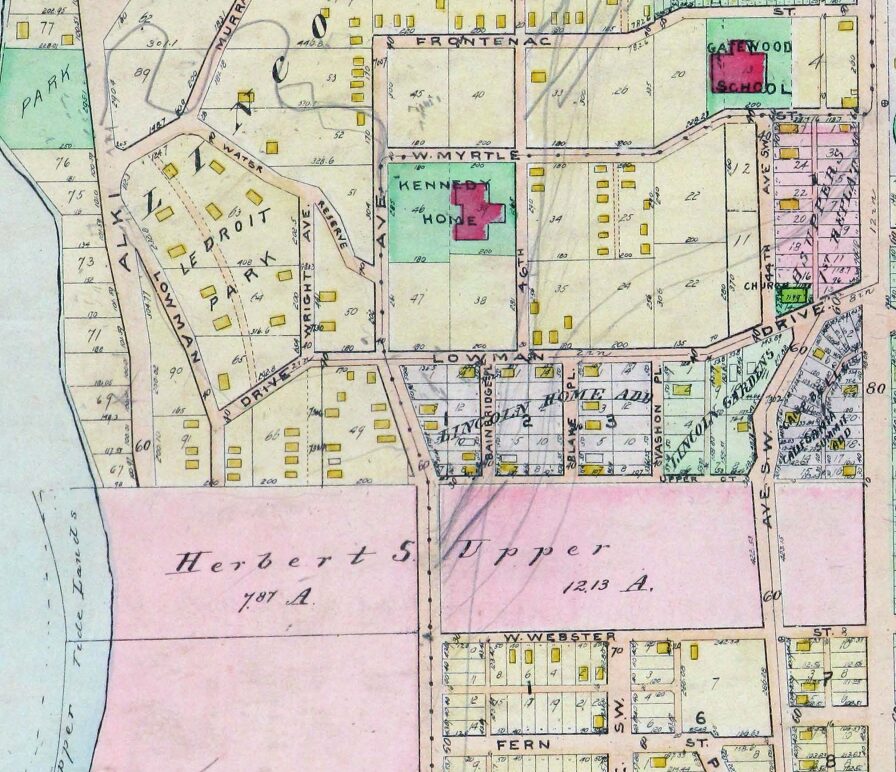
This West Seattle street was created as part of the plat of Woodside, an Addition to the City of Seattle, filed on June 17, 1919, by Eugene E. Harold, and named for the subdivision. I don’t think it’s too much of a stretch to assume the subdivision was so named because of its proximity to the wooded area that is now Lincoln Park.

Woodside Place SW begins at SW Myrtle Street just south of Gatewood Elementary School and goes just over 600 feet south to SW Othello Street.

Detail of 1912 Baist atlas of Seattle showing current location of Woodside Place
Detail of 1912 Baist atlas of Seattle showing current location of Woodside Place, south of W Myrtle Street (now SW Myrtle Street) just southwest of Gatewood Elementary School. The vacant land shaded in pink as and noted as belonging to Herbert S. Upper is now part of Lincoln Park (along Puget Sound) and Solstice Park, formerly Lincoln Park Annex (to the east, between what are now Fauntleroy Way SW and 44th Avenue SW).

Ward Place

This block-long Queen Anne street is named for Ward Street, itself named after Dillis B. Ward (1838-1922). It was established in 1903 by Ordinance 9310 as East Queen Anne Drive. It may have been renamed later that year by Ordinance 10261, but as the latter ordinance has not yet been scanned by the city, we know it amends the section of the earlier ordinance dealing with the street — but not exactly how.

Ward Place begins at Taylor Avenue N just north of Aloha Street and goes 330 feet northeast to Ward Street just west of 6th Avenue N (intersection pictured below).

Street sign at corner of Ward Street and Ward Place
Photograph by Benjamin Lukoff, February 2024. Copyright © 2024 Benjamin Lukoff. All rights reserved.

Incidentally, Seattle City Councilman Hiram C. Gill (1866–1919), who would go on to become mayor from 1910–1911 and 1914–1918, was adamantly against its construction, and was no fan of the residents of East Queen Anne, either:

Just a few nights ago those yellers up there held a meeting and denounced this council as a lot of grafters that were into all kinds of corruption, and now they come right down here and demand that we give them something that nobody else would have the gall to ask for. It is time that bunch should be set back a little. There are only about two dozen people living up there anyway and there is no reason why a lot of money should be spent for improvements for a handful of people when no other part of the city can get anything in the way of special favors. That crowd up there has been getting one thing after another just because they holler for it. They are just a lot of cheeky grafters anyway. I wouldn’t care if there was any kind of decent people living up there but if those fellows had to walk up hill every day and then were put in jail and kept there until Hades froze over they would be getting just about what they want.

Article in the December 22, 1903, issue of the Seattle Post-Intelligencer regarding East Queen Anne Drive, now Ward Place
Article in the December 22, 1903, issue of the Seattle Post-Intelligencer

Mountain View Drive S

This street, created in 1923 by Ordinance 45500, received its current name in 1929. Before then, it was part of 28th and 29th Avenues S. The mountain in question would be Mount Rainier, which, it was recently announced, is no longer 14,410 feet high, but rather 14,399.6, due to a melting icecap.

Mountain View Drive S begins at S Columbian Way and S Alaska Street and goes ⅙ of a mile southeast to 29th Avenue S and S Edmunds Street.

Montvale Place W

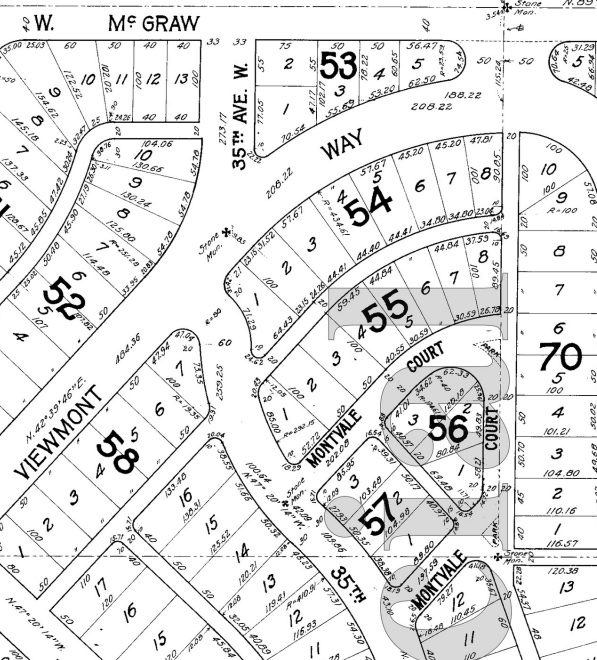
What is now Montvale Place W was originally Montvale Court W, created in 1915 as part of the plat of Carleton Park. When originally platted, Montvale Court formed a horseshoe-shaped loop, but at some point (the quarter section map doesn’t say, and I can find no relevant city ordinance), the eastern and southeastern part of the street, plus the alley connecting to 34th Avenue W, was renamed Montvale Place W.

Montvale Place W begins at 35th Avenue W south of Montvale Court W and goes ⅛ of a mile northeast, then north, to the intersection of Viewmont Way W, 34th Avenue W, and W Lynn Street.

Portion of plat of Carleton Park showing original course of Montvale Court W
Portion of plat of Carleton Park showing original course of Montvale Court W, over half of which is now Montvale Place W

Montvale Court W

Like Viewmont Way W, Crestmont Place W, Eastmont Way W, Westmont Way W, and Piedmont Place W, this street was created in 1915 as part of the plat of Carleton Park, their common mont element referring to the fact that, as The Seattle Times wrote, the “entire district commands an unobstructible view of the Cascade and Olympic Mountains.” Like Piedmont Place W, Montvale Court W lies at the foot of the western Magnolia hill as it slopes down to Pleasant Valley (of which vale is of course a variant).

Montvale Court W begins at 35th Avenue W south of Viewmont Way W and goes just over 300 feet northeast to Montvale Place W. (When it was originally platted, it formed a horseshoe-shaped loop back to 35th, but at some point the eastern and southeastern part of the street was renamed Montvale Place W.)

Portion of plat of Carleton Park showing original course of Montvale Court W

Chris Curtis Way

In March 2019, the block of University Way NE between NE 50th Street and NE 52nd Street was given the honorary name of Chris Curtis Way. This block is home to the weekly, year-round University District Farmers Market. Founded in 1993 by Chris Curtis and others, it was the first of what are now seven farmers markets spread across the city. As the city council resolution states, Curtis received this honor for, among other things,

…Organiz[ing] the first neighborhood farmers markets in Seattle devoted exclusively to local, small-scale family farms, which focus on good land stewardship and biodiversity and are essential components of a healthy environment, thriving local economy, and safe food system; and… help[ing] to preserve farmers’ livelihoods, revitalize neighborhoods, and support and strengthen Washington’s small family farm industry.

Curtis retired as executive director of the Neighborhood Farmers Market Alliance in 2018.

Chris Curtis Way sign, University Way NE, Seattle
Chris Curtis Way sign, University Way NE at NE 50th Street, February 6, 2024. Photograph by Zev Handel, Copyright © 2024 Zev Handel. All rights reserved.

Candy Cane Lane

It’s that time of year again, when NE Park Road and Park Road NE (which form a loop connecting Ravenna Avenue NE and 21st Avenue NE north of NE Ravenna Boulevard) transform themselves into Candy Lane Lane. A Christmas tradition which began 75 years ago, it’s, as local historian Valarie Bunn describes it,

A fun family holiday event in northeast Seattle… a cluster of houses all decked out in lights and themed decorations.… Pedestrians are welcome at all times, and you are encouraged to walk through for a closer look at the lights and decorations. 

Visit her blog post or the Candy Cane Lane Facebook page for more details. The display runs through January 1.

Candy Cane Lane Season's Greetings sign, December 2013
Season’s Greetings from Candy Cane Lane sign, December 2013. Photograph by Flickr user Frank Fujimoto, licensed under Creative Commons Attribution-NonCommercial-NoDerivs 2.0 Generic

Seattle Storm Way

This pedestrianized stretch of 2nd Avenue N on the Seattle Center campus was renamed in 2018 after the Seattle Storm WNBA team, themselves so named “because of the weather here and what the team plans to do in the league.” Founded in 2000, their home court is Climate Pledge Arena, located between Seattle Storm Way and 1st Avenue N along Lenny Wilkens Way (formerly the 100 block of Thomas Street)

Before the 1962 Century 21 Exposition that brought Seattle the Space Needle and Monorail, 2nd Avenue N (earlier Poplar Avenue) continued north to Mercer Street and up Queen Anne Hill. The stretch between Thomas and Mercer Streets would remain a public right-of-way after its pedestrianization for nearly 30 years until it was vacated in 1991 at the request of Seattle Center “for the purpose of security and event control.”

Seattle Storm Way begins at Lenny Wilkens Way and goes a block north to the old Harrison Street right-of-way; the walkway between there and Mercer Street remains unnamed.

Seattle Storm logo
Seattle Storm logo

Ridgemont Way N

This street was created in 1925 as part of the plat of Ridgemont. Unnamed at the time, it was presumably later named after the subdivision. I say “presumably” because there is no record of its being named in Seattle’s online legislative database, which there should be if this was done after this part of town was annexed in 1953, and King County’s only goes back to 1969.

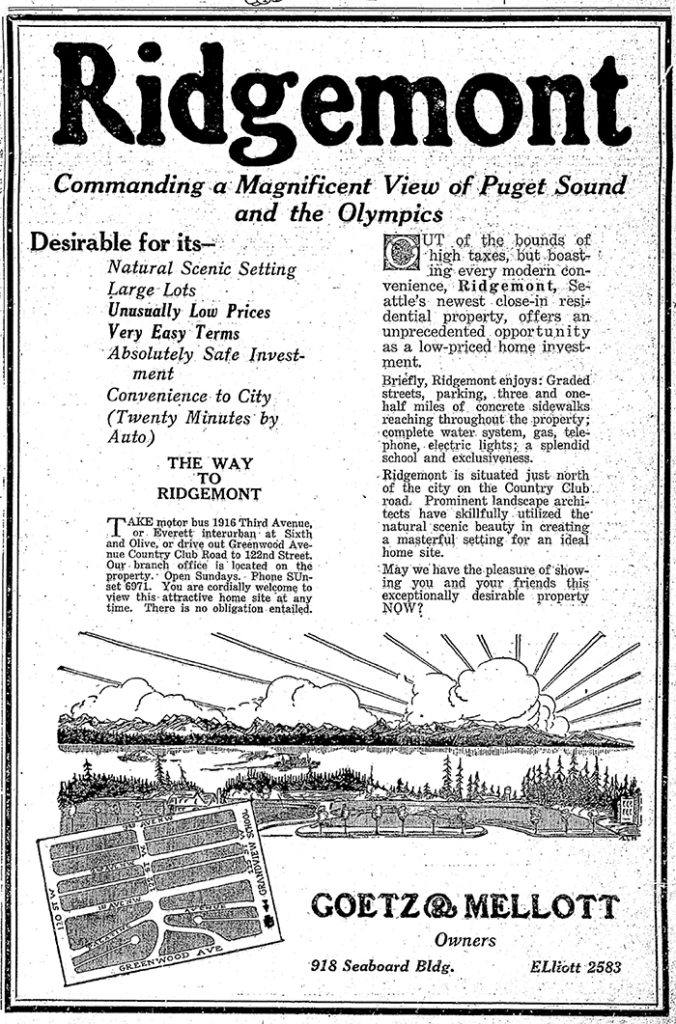
Ridgemont, as the below advertisement implies, was named for its location atop a ridge “commanding a magnificent view of Puget Sound and the Olympics.”

Ridgemont Way N begins at Greenwood Avenue N just south of N 125th Street and goes just over 425 feet southwest to N 122nd Street.

Advertisement for the Ridegmont subdivision, The Seattle Times, October 11, 1925
Advertisement for the Ridegmont subdivision, The Seattle Times, October 11, 1925. It would remain outside of the city and “out of the bounds of high taxes” for 28 years.

Friends of Street Ends celebrates 30th anniversary Saturday, September 30, 2023

Friends of Street Ends, which I mention in my article on Mercer Street, is celebrating its 30th anniversary in just over a week, on Saturday, September 30. I will likely not be able to make it to this event myself, but I encourage anyone who can attend to do so. They put out this press release this afternoon:

Friends of Street Ends: Celebrating 30 years of improving Seattle's shoreline access, September 30, 2023, 4-6 p.m., E. Harrison Street End


Protectors of Public Shorelines Celebrate 30 Years

For more than 30 years, Friends of Street Ends has improved public shoreline access in the City of Seattle. As a result, the city is now home to more than 142 street ends — most open to the public. These public spaces, all special and unique, dot our city’s many bodies of water, where roadways end at the shorelines of Lake Union, Lake Washington, the Ship Canal, Puget Sound and the Duwamish River.

In 1993 founders Karen Daubert and John Barber, along with a small group of volunteers, started Friends of Street Ends as a community response to the city’s lack of management and protection of these public spaces. At the time, about one third of the street ends were taken over by adjacent neighbors who had fenced off the public property for their private use. Other sites were inaccessible due to overgrown vegetation. With the blessing of the city’s then engineering department, they improved and opened the first 4 street ends, the “String of Pearls” in the Leschi neighborhood.

FOSE volunteers helped draft the city’s first legislation that put in writing the principle that shoreline street ends should be protected, open for public access, and that the “highest and best use” of shoreline street ends was, in fact, public access. FOSE works with Seattle Department of Transportation to encourage removal of private encroachments. The removal of all private encroachments remains an important goal for the organization.

Today, FOSE continues to work with residents and city staff to keep street ends healthy, and to ensure water access and views are accessible to all.

The FOSE 30th anniversary Celebration will be Saturday, September 30, from 4–6 pm. at the E. Harrison Street End (aka “Hidden Beach”).

There will be a brief presentation about the history of Seattle’s Shoreline Street Ends program and Friends of Street Ends, refreshments, and opportunities to learn more about local street ends, as well as to become a steward or join a work party. Details below:

  • Event: Friends of Street Ends 30th Anniversary Celebration
  • Date: Saturday, September 30
  • Time: 4–6 p.m.
  • Location: E. Harrison Street End (39th Ave. E. and E. Harrison St.)
    In the Denny/Blaine neighborhood, on the shore of Lake Washington
    Access from 39th Ave E., between Lake Washington Blvd E. and E. Mercer St.
  • Contact: For more information or to schedule an interview, contact Friends of Street Ends Co-chair and Co-founder Karen Daubert (karendaubert@msn.com) or Co-chair Marty Oppenheimer (marty@oppcam.com).

Fairview Place N

This street was created in 1988 as part of the development of Chandler’s Cove, now being redeveloped as Lake Union Piers. Beginning at Fairview Avenue N between Valley Street and Aloha Street and going just over 125 feet north to Waterway 5 on Lake Union, it was presumably named after the avenue.

Fairview Avenue N was itself established as Lake Street in the 1875 plat of the Fairview Homestead Association for the Benefit of Mechanics and Laborers, and received its current name during the Great Renaming of 1895. The name likely references the view of Lake Union and Wallingford that was once visible from most of the Cascade neighborhood.

Stadium Place S

This private street begins at 2nd Avenue S and S King Street and goes 300 feet south to the north parking lot of Lumen Field. It was created in 2011 as part of the Stadium Place development, after which it was named. The development, in turn, was so named for its proximity to Lumen Field, known as Seahawks Stadium from 2002 to 2004, Qwest Field from 2004 to 2011, and CenturyLink Field from 2011 to 2020.

“The Wave” — the west tower of the Stadium Place complex — as seen from the parking lot of Lumen Field in August 2017
“The Wave” — the west tower of the Stadium Place complex — as seen from the parking lot of Lumen Field in August 2017. Stadium Place S is the street to the north of the parking lot, where the white van is parked behind the orange bollards. Photograph by Wikimedia Commons user Joe Mabel, licensed under Creative Commons Attribution 4.0 International.

Convention Place

This street was created in 1966 as Union Place, a state-owned frontage road for the recently constructed Interstate 5. (Construction of an earlier, nearby Union Place had been approved and then repealed in 1902.) It was renamed Convention Place in 1988 when the city took ownership as part of the construction of the Washington State Convention Center, which became the Seattle Convention Center in 2022.

Formerly open to the air, Convention Place became a tunnel during the construction of the convention center, which was built over it and Interstate 5. It begins at the intersection of 9th Avenue and Pike Street and goes ⅛ of a mile southwest to Union Street just before its intersection with 7th Avenue.

convention center lid looking south
Looking south from the I-5 Pine Street overpass toward Pike Street and the Convention Center, June 2015. The Paramount Theatre is just visible at far right, and just to the left of that, at 9th Avenue and Pike Street, is where Convention Place begins. Photograph by Flickr user SounderBruce, licensed under Creative Commons Attribution-ShareAlike 2.0 Generic
convention center looking west down pike
Looking southwest down Pike Street from Hubbell Place, May 2017. Convention Place begins at the traffic signal. Photograph by SounderBruce, Wikimedia Commons, licensed under Creative Commons Attribution-ShareAlike 4.0 International

Sound View Terrace W

This street was created in 1905 as part of the plat of the Sound View Addition to Queen Anne. Originally a loop off 11th Avenue W and carrying that name, at some point it was renamed after the addition — which itself was named for its fine view of Puget Sound. (I have been unable to find the renaming ordinance, so don’t know exactly when the change was made.)

Smith Cove from Soundview Terrace Park, July 2008
Smith Cove, Interbay, and Magnolia from Soundview Terrace Park, July 2008. The industrial area at center is the Port of Seattle’s Terminal 91, the BNSF Railway’s Balmer Yard, and the Washington National Guard’s Seattle Readiness Center. Beyond the Magnolia Bridge is the Elliott Bay Marina. Photograph by Joe Mabel, Wikimedia Commons, licensed under Creative Commons Attribution-Share Alike 3.0 Unported
Soundview Terrace playground
Soundview Terrace Playground, July 2015. Sound View Terrace W is between the playground and the houses, all of which have Westview Drive W or 11th Avenue W addresses. Courtesy of the Seattle Municipal Archives, Identifier 178590
Portion of 1905 Plat of Sound View Addition to Queen Anne
Portion of the 1905 plat. Smith and Wild Rose Streets are now W Wheeler Street; the curving portion of 11th Avenue W is now Sound View Terrace W.

Dzidzilalich

As I wrote in “Dzidzilalich” to be honorary name for Elliott Way, Alaskan Way, the Lushootseed place name Dzidzilalich has become Seattle’s newest honorary street name. Pronounced dzee-dzuh-lah-leech, it means means “Little Crossing Over Place,” and is the name of a Duwamish village whose site is now covered by Downtown Seattle.

Mockup of a brown street sign reading Dzidzilalich

The designation applies to Elliott Way for its entire length, beginning at Western Avenue and Bell Street and heading southeast to where it meets Alaskan Way at Pine Street. It then continues on Alaskan Way to its intersection with S Dearborn Street, for a total length of 1¼ miles. (Why it doesn’t apply to Alaskan Way for its entire length, I am not sure.)

Where springs of clear water bubbled from the earth and the beach was sandy and free from rocks, there the Indians camped. Such a choice spot was Tzee-tzee-lal-litch, which Arthur Denny called Spring Street.

Sophie Frye Bass, “Pig-Tail Days in Old Seattle

Elliott Way

Seattle’s newest street opened to traffic May 1 — but it has a rather old name.

Elliott Way, which also carries the honorary name Dzidzilalich, is named for Elliott Avenue, which in turn was named in 1895 for Elliott Bay — itself named in 1841 after Midshipman Samuel Bonnyman Elliott (1822–1876), part of the Wilkes Expedition.

The new road begins at the intersection of Western Avenue and Bell Street and goes ⅓ of a mile southeast to Alaskan Way and Pine Street.

Elliott Way, spring 2023, looking north
Looking north on Elliott Way, shortly before opening, spring 2023. The Lenora Street pedestrian bridge can be seen crossing the railroad tracks at center; the Norwegian Bliss cruise ship is at upper left, docked at the Bell Street Cruise Terminal (Pier 66). Photograph courtesy of Ryan Packer. Copyright © 2023 Ryan Packer. All rights reserved.
Elliott Way, spring 2023, looking south
Looking south on Elliott Way, shortly before opening, Spring 2023. The Elliott Pointe building is at right and the “Blanchard Street Opportunity Site” at left. The intersection of Elliott Way and Elliott Avenue is at center. Photograph courtesy of Ryan Packer. Copyright © 2023 Ryan Packer. All rights reserved.