S Camano Place

This street, created in 1931, was almost certainly named for Camano Island (known as ʔəw̓alus in Lushootseed), which is located, as Wikipedia tells us, in Puget Sound “between Whidbey Island and the mainland… by the Saratoga Passage to the west and Port Susan and Davis Slough to the east.” The timeline of its naming:

  • The strait connecting Puget Sound to the Strait of Juan de Fuca was named Ensenada de Caamaño by the Quimper Expedition in 1790. Jacinto Caamaño Moraleja was a fellow Spanish explorer of the Pacific Northwest.
  • This strait was renamed Admiralty Inlet by the Vancouver Expedition in 1792.
  • ʔəw̓alus was named Macdonough Island by the Wilkes Expedition in 1841.
  • In 1847, Vice Admiral Sir Henry Kellett of the Royal Navy resurrected the Camano name (after having altered its spelling) and applied it to Macdonough Island.

S Camano Place begins at Renton Avenue S between S Thistle Street and S Cloverdale Street and goes 425 east to a cul-de-sac.

Parshall Place SW

This West Seattle street was created in 1946 by Ordinance 75595 and expanded nearly 40 years later by Ordinance 112188. However, it was named after an earlier Parshall Place, created in 1909 as part of the Replat of Blocks 2, 5, and 6, Lincoln Beach Park. That street is now the north 215 feet of Glenridge Way SW between SW Othello Street and Gatewood Road SW. The “new” Parshall Place begins 1,000 feet due north of SW Othello Street, at SW Frontenac Street.

The two men who notarized the signatures of the men and women executing the plat were Willard C. Haring and L.A. Parshall. I take it this is the same Parshall as in L.A. Parshall & Co., which sold real estate from offices at 318 Colman Building. Louis Ayers Parshall was born in 1870 and died in 1950. His wife, Martha Ida Funk (1871–1964), was the niece of Isaac Kaufmann Funk (1839–1912), co-founder of Funk & Wagnalls, the reference book publisher.

As noted, Parshall Place SW begins at SW Frontenac Street and goes around 860 feet north to SW Holly Street, its middle third being a footpath connecting the two alley-like segments.

Real estate ad by L.A. Parshall & Co. on page 57 of the April 14, 1907, issue of The Seattle Times
Real estate ad by L.A. Parshall & Co. on page 57 of the April 14, 1907, issue of The Seattle Times. I’m not sure which corner(s) of 6th Avenue and Spring Street were for sale, but today Interstate 5 and Freeway Park take up the northeast and southeast corners. Parshall Place SW, meanwhile, is a block east of California Avenue SW.

S Eastwood Drive

This street was created in 1955 as part of the plat of the Lowrain Park Addition, filed by A.L. Wood and J.E. Wood of Lowrain Park, Inc. Their full names would appear to be Adlai Lorain Wood (1891–1981) and Jack Earl Wood (1919–1995), his son. I am going to guess they named the street after themselves, the subdivision being in the southeasternmost part of the city.

S Eastwood Drive begins at 59th Avenue S and goes a block east to 61st Avenue S.

E McGilvra Street

This street was created in 1919 as part of the plat of the Loch-Gilvra Addition to the City of Seattle, filed by Oliver C. McGilvra (1867–1955) and Charles L. Denny (1861–1919) as executors of the estate of John J. McGilvra (1827–1903), Oliver’s father, as well as by Oliver and his sister, Caroline Burke (1857–1932), in their own right. See McGilvra Boulevard E for more information on McGilvra père.

E McGilvra Street begins at 43rd Avenue E and goes around 2,000 feet west to 37th Avenue E, intersecting with McGilvra Boulevard E at the halfway point.

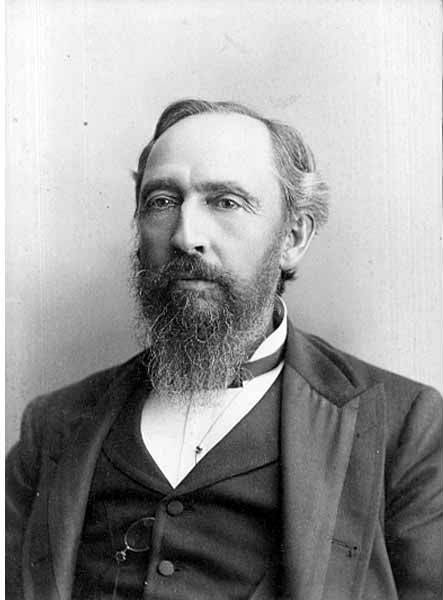
John J. McGilvra, circa 1890

N Menford Place

This street was created in 1907 as part of Tronstad’s Addition to the City of Seattle, filed by Norwegian immigrants Nils and Bertha Tronstad and another couple. It appears to have been named after the Tronstads’ first child and only son, Menford Tronstad (1904–2001).

N Menford Place begins at Stone Way N between N 42nd and N 43rd Streets and goes around 200 feet east to a dead end.

S Raymond Place

This cul-de-sac was created in 1984 as part of the plat of Valley Ridge, and was named after the nearby S Raymond Street. Raymond Street was itself named by and for Herbert R. Raymond (1862–1933), and his wife, Minnie M. Raymond (1874–1947), née Truax.

Herbert Raymond
Herbert Raymond in May 1922 ― see S Raymond Street for the Seattle Times article this photo was taken from

S Raymond Street

This street was named in 1906 as Raymond Avenue, part of Replat Tracts 30 & 31 Sunnyside 5 Acre Tracts, by Herbert R. Raymond (1862–1933) of New Brunswick, Canada, and his wife, Minnie M. Raymond (1874–1947), née Truax, of Massachusetts. In 1907, it and Spencer Avenue became Raymond Street as part of the renaming of streets in Beacon Hill and Rainier Valley, and Grand Avenue, Grand View Avenue, and Sixteenth Street in West Seattle took the name as well. Three years later, when Georgetown was annexed, Raymond Street replaced James Street. (All this information from Rob Ketcherside’s extremely useful searchable table of street name changes.)

Herbert came to Washington as a child, along with his family; Minnie appears to have come later, and the two married in 1895. His eldest brother, George (Herbert was the youngest of eight children), sold shoes in Seattle and was also on the city council and in the territorial, as it then was, legislature. He later moved to Bellingham and was on the city council there in 1912 and 1913, and was mayor for less than two months, in December 1915 and January 1916, his term ending with his sudden death.

Herbert himself was also in the shoe business. As his Seattle Times obituary put it, he was:

Formerly one of the Pacific Northwest’s prominent shoe merchants and leading civic spirits… He had been retired for the past twelve years and had spent most of his time out of doors improving his two-acre residential property which overlooks Lake Washington. Mr. Raymond came to Seattle four years before the Seattle fire and helped fight it. His first shoe store was at First Avenue near Madison Street. He operated in other locations and under other firm names in subsequent years.

Article in the May 7, 1922, Seattle Times, about wildlife on Raymond's property
Article in the May 7, 1922, Seattle Times, about deer grazing on Herbert Raymond’s lawn and in his orchard. “I believe they came originally from Mercer Island, swimming across to Seward Park. There are no dogs about and the tempting green stuff in my garden coaxed them over the fence…. I don’t see a chance to grow a garden. But the deer are worth it. Their beauty more than repays for their feed.” Download the article as a PDF.

S Raymond Street begins at 51st Place S and goes just over ⅕ of a mile west to 48th Avenue S. It resumes at 44th Avenue S and goes a block west to 42nd Avenue S. There is another short segment that goes 1½ blocks west from Martin Luther King Jr. Way S, and then a longer segment begins at 33rd Avenue S and goes ½ a mile west to Beacon Avenue S, the portion crossing the Chief Sealth Trail being a pathway. A few more segments appear between 24th Avenue S and Swift Avenue S.

SW Raymond Street begins in West Seattle at High Point Drive SW and SW Graham Street and goes 1¼ miles west to 49th Avenue SW.

Triton Drive NW

This street was established in 1926 as part of North Beach, an Addition to the City of Seattle, which overlooks Puget Sound. Just as my assumption is NW Neptune Place was so named because Neptune is the Roman god of the sea, I assume Triton Drive was so named because Triton is his son.

Triton Drive NW begins at 28th Avenue NW and NW 96th Street and goes around 870 feet northeast to an intersection with NW Esplanade, where it becomes NW Blue Ridge Drive.

NW Neptune Place

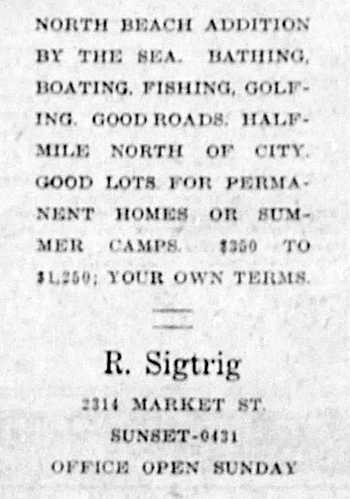
This street was established in 1926 as part of North Beach, an Addition to the City of Seattle. As the advertisement below indicates, the addition features excellent views of Puget Sound. I assume Neptune being the Roman god of the sea was the inspiration behind the name.

North Beach Ad, Seattle Star, September 17 1925
Advertisement for the North Beach Addition in the September 17, 1925, issue of The Seattle Star

NW Neptune Place begins at NW Blue Ridge Drive and NW 100th Street and goes around 650 feet southeast to NW 98th Street and 24th Avenue NW.

Dave Niehaus Way S

Note: This was originally published on Crosscut.com on April 4, 2011, as ‘Niehaus Way South: a nice tribute, or half of one anyway’ (reminder: stringers don’t write their own headlines). Recently, Cascade PBS took down what appears to be most of the stories from the Crosscut days, so I thought I’d repost some of my articles here. The original subhed was:

The new ‘designation’ for one stretch of First Avenue South will honor the late Mariner broadcaster without fully renaming the street. Here’s why that’s a good thing.

Later today (April 4), nearly 32 years to the day after S. Connecticut Street was renamed S. Royal Brougham Way for the late P-I sportswriter, the Seattle City Council is expected to honor another sports legend with a SoDo street. First Avenue South between Royal Brougham and Edgar Martinez Drive South will receive a “secondary designation” of Dave Niehaus Way South.

Though official, it is not a renaming in the same way Connecticut and Atlantic became Royal Brougham and Edgar Martinez, or Airport Way in front of the old INS building reverted to its historic name of Seattle Boulevard. As councilmember Sally Clark notes in the April edition of her email newsletter, “it will still be First Ave. S. on your street maps and GIS systems, but you’ll see a special brown sign with Dave’s name.”

Clark’s office says the Mariners are paying for the installation, and that there will be an unveiling on April 8, the day of the Mariners’ home opener. “The street naming is one tribute among many,” said Clark, when asked for comment. “I hope the signs remind people of Dave’s voice and of great plays seen from the stands or heard on the radio.”

”By renaming this street, we affirm that the legend of Dave Niehaus will never die,” said Glen Garnett, paraphrasing a line from “The Sandlot.” Garnett originally wanted to rename this stretch of First Avenue after Ken Griffey, Jr., but redirected his efforts after Niehaus’ death.

So what does this mean for proposals to name Seattle’s alleys and other unnamed spaces? A year ago, Crosscut’s Knute Berger wrote that “honorary names … won’t show up on maps or as addresses, and they can cause confusion… they can become controversial for being too outlandish, too commercial, or not politically correct.” But they could nevertheless be the best way forward. Budgets may never again allow for Great Renamings, but nothing should stand in the way of projects with smaller scope, catalogued online, funded by local property owners or heritage groups, and approved in, say, twice-yearly batches.

Pioneer Square’s Nord Alley, Downtown’s News Lane, and Denny-Blaine’s Swanson’s Alley are among the initial candidates I’d put forward. Yesler Terrace is another possibility. Regardless of one’s position on its redevelopment, a nod to Jesse Epstein and Nihonmachi (Japantown) seems in order. Considering the current and likely future funding environment, “secondary designations” deserve a serious look as a cost-effective way to bring a sense of place and history to the streets of Seattle.

Balmer Yard

In June 2025, the BNSF Railway‘s Balmer Yard in Magnolia/Interbay closed. Nothing had appeared in the news as of the end of the month — just in Facebook groups and railroading bulletin boards — but it looks as if over a century of railroad operations in the neighborhood has come to an end (with the exception of the BNSF main line, known here as the Scenic Subdivision).

Update as of June 26, 2025: Feliks Banel has received this statement from BNSF:

Driven by the success of efficiency initiatives across our network, rail cars are spending much less time dwelling in yards and more time moving the nation’s freight. This increase in productivity has allowed us to move more freight than this time last year with significantly fewer cars. Given the close proximity of our Seattle Stacy Yard and Balmer Yard, with fewer cars sitting in terminals, we were able to consolidate the two operations into one location.

Although we are not actively switching or repairing cars at Balmer Yard, it is still critical to our overall capacity and operations. We are utilizing the facility to position cars for future customer shipments such as intermodal, lumber, and grain to be quickly injected into our network. All employees that previously went on duty at Balmer were shifted to nearby locations in Tacoma, Seattle and Everett.

The yard, originally known as Interbay Yard and first mention in The Seattle Times in 1900, was renamed for Thomas Balmer (1888-1959) in 1968 upon its modernization into a hump yard, which took advantage of the 1% grade of the land that had formerly been part of the Smith Cove tideflats.

Balmer began working at the Great Northern Railway in 1907, seven years after he moved to Seattle from Illinois. He went to law school while working there, and by 1929 had become vice president and Western counsel. Balmer retired from the GN in 1958, a year before his death. (In 1970, the GN merged with the Northern Pacific Railway; the Spokane, Portland and Seattle Railway; and the Chicago, Burlington and Quincy Railroad to form the Burlington Northern Railroad. BN itself merged with the Atchison, Topeka and Santa Fe Railway in 1996 to form today’s BNSF.)

Balmer was also a real estate investor and a regent of the University of Washington. It is for this latter service, from 1934 until his death, that he was honored by the longtime home of the University of Washington School of Business, Balmer Hall. Completed in 1962, it was demolished in 2010.

Thomas Balmer
Thomas Balmer in photo accompanying his obituary in The Seattle Times, August 1, 1959

Howell Place

This street was named in 1923 by Ordinance 45722, which provided that:

That certain alley in the City of Seattle, being the alley in Block one (1), Yesler & McGilvra Addition, running from East Howell Street to East Olive Street, and lying between Fortieth Avenue and Lake Washington, be and the same is hereby designated as, and named, EAST HOWELL PLACE.

It was named after E Howell Street, itself named for Jefferson Davis Howell (1846–1875).

Howell Place begins at E Howell Street just east of Lake Washington Boulevard and goes just under 400 feet south to E Olive Lane.

Gatewood Road SW

This West Seattle street was created in 1909 as part of the Replat of Blocks 2, 5, and 6, Lincoln Beach Park. Based on its proximity to the Gatewood Acre Tracts and Gatewood Gardens subdivisions, it would appear to have been named for the developer Carlisle Gatewood (1860–1947), after whom Gatewood Elementary School and the Gatewood neighborhood itself are also named.

Gatewood Road SW begins at Glenridge Way SW south of SW Othello Street and goes around 850 feet southeast to 40th Avenue SW north of SW Webster Street.

Obituary of Carlisle Gatewood from May 30, 1947, issue of The Seattle Times
Obituary of Carlisle Gatewood, from the May 30, 1947, issue of The Seattle Times

Ward Place

This block-long Queen Anne street is named for Ward Street, itself named after Dillis B. Ward (1838-1922). It was established in 1903 by Ordinance 9310 as East Queen Anne Drive. It may have been renamed later that year by Ordinance 10261, but as the latter ordinance has not yet been scanned by the city, we know it amends the section of the earlier ordinance dealing with the street — but not exactly how.

Ward Place begins at Taylor Avenue N just north of Aloha Street and goes 330 feet northeast to Ward Street just west of 6th Avenue N (intersection pictured below).

Street sign at corner of Ward Street and Ward Place
Photograph by Benjamin Lukoff, February 2024. Copyright © 2024 Benjamin Lukoff. All rights reserved.

Incidentally, Seattle City Councilman Hiram C. Gill (1866–1919), who would go on to become mayor from 1910–1911 and 1914–1918, was adamantly against its construction, and was no fan of the residents of East Queen Anne, either:

Just a few nights ago those yellers up there held a meeting and denounced this council as a lot of grafters that were into all kinds of corruption, and now they come right down here and demand that we give them something that nobody else would have the gall to ask for. It is time that bunch should be set back a little. There are only about two dozen people living up there anyway and there is no reason why a lot of money should be spent for improvements for a handful of people when no other part of the city can get anything in the way of special favors. That crowd up there has been getting one thing after another just because they holler for it. They are just a lot of cheeky grafters anyway. I wouldn’t care if there was any kind of decent people living up there but if those fellows had to walk up hill every day and then were put in jail and kept there until Hades froze over they would be getting just about what they want.

Article in the December 22, 1903, issue of the Seattle Post-Intelligencer regarding East Queen Anne Drive, now Ward Place
Article in the December 22, 1903, issue of the Seattle Post-Intelligencer

Elliott Way

Seattle’s newest street opened to traffic May 1 — but it has a rather old name.

Elliott Way, which also carries the honorary name Dzidzilalich, is named for Elliott Avenue, which in turn was named in 1895 for Elliott Bay — itself named in 1841 after Midshipman Samuel Bonnyman Elliott (1822–1876), part of the Wilkes Expedition.

The new road begins at the intersection of Western Avenue and Bell Street and goes ⅓ of a mile southeast to Alaskan Way and Pine Street.

Elliott Way, spring 2023, looking north
Looking north on Elliott Way, shortly before opening, spring 2023. The Lenora Street pedestrian bridge can be seen crossing the railroad tracks at center; the Norwegian Bliss cruise ship is at upper left, docked at the Bell Street Cruise Terminal (Pier 66). Photograph courtesy of Ryan Packer. Copyright © 2023 Ryan Packer. All rights reserved.
Elliott Way, spring 2023, looking south
Looking south on Elliott Way, shortly before opening, Spring 2023. The Elliott Pointe building is at right and the “Blanchard Street Opportunity Site” at left. The intersection of Elliott Way and Elliott Avenue is at center. Photograph courtesy of Ryan Packer. Copyright © 2023 Ryan Packer. All rights reserved.

Mount Adams Place S

Like Mount Rainier Drive S, Mount St. Helens Place S, and S Mount Baker Boulevard, this street was created in 1907 as part of the Mt. Baker Park addition, named for its view of Mount Baker in the North Cascades. Like the others, it was named after a prominent Cascade Range peak — in this case, Mount Adams.

At 12,281 feet, Adams is the second tallest mountain in Washington, behind Mount Rainier. Known by Native Americans as Pahto or Klickitat, it was named for President John Adams (1735–1826), in a rather roundabout way. Unlike Rainier or St. Helens, it was neither “discovered” by George Vancouver nor named by him; instead, the first non-Natives to spot it were Lewis and Clark, who at first thought they had spotted St. Helens. Then, as Wikipedia relates,

For several decades after Lewis and Clark sighted the mountain, people continued to get Adams confused with St. Helens, due in part to their somewhat similar appearance and similar latitude. In the 1830s, Hall J. Kelley led a campaign to rename the Cascade Range as the President’s Range and rename each major Cascade mountain after a former president of the United States. Mount Adams was not known to Kelley and was thus not in his plan. Mount Hood, in fact, was designated by Kelley to be renamed after President John Adams and St. Helens was to be renamed after George Washington. In a mistake or deliberate change by mapmaker and proponent of the Kelley plan Thomas J. Farnham, the names for Hood and St. Helens were interchanged. And, likely because of the confusion about which mountain was St. Helens, he placed the Mount Adams name north of Mount Hood and about 40 miles (64 km) east of Mount St. Helens. By what would seem sheer coincidence, there was in fact a large mountain there to receive the name. Since the mountain had no official name at the time, Kelley’s name stuck even though the rest of his plan failed. However, it was not official until 1853, when the Pacific Railroad Surveys, under the direction of Washington Territory governor Isaac I. Stevens, determined its location, described the surrounding countryside, and placed the name on the map.

Mount Adams Place S begins at Mount St. Helens Place S and goes ¼ mile southeast to S Ferris Place.

Mount St. Helens Place S

Like Mount Rainier Drive S and S Mount Baker Boulevard, this street was created in 1907 as part of the Mt. Baker Park addition, named for its view of Mount Baker in the North Cascades. The neighborhood featured a number of other streets named for mountains in the Cascade Range, including this one, named after Mount St. Helens.

St. Helens, of course, is best known for its volcanic eruption on May 18, 1980, “the deadliest and most economically destructive volcanic event in U.S. history” according to Wikipedia. It was variously known by the Native Americans as Lawetlat’la (Cowlitz) and Loowit or Louwala-Clough (Klickitat), and, like Mount Rainier and Mount Baker, was given its official English-language name by George Vancouver on HMS Discovery in 1792. In this case, it honored his friend Alleyne FitzHerbert, 1st Baron St Helens (1753–1839), who at the time was British ambassador to Spain.

Mount St. Helens Place S begins at Cascadia Avenue S and goes just over ¼ mile south to Mount Rainier Drive S at 37th Avenue S.

Mount Rainier Drive S

This street was created in 1907 as part of the Mt. Baker Park addition, named for its view of Mount Baker in the North Cascades. In addition to S Mount Baker Boulevard, the neighborhood featured a number of other streets named for mountains in the Cascade Range, including this one, named after Mount Rainier.

According to Wikipedia, at 14,411 feet, Mount Rainier is “the highest mountain in… Washington and the Cascade Range, the most topographically prominent mountain in the contiguous United States, and the tallest in the Cascade Volcanic Arc.” It has been known by a number of other names, including Tacoma (after which, incidentally, Takoma Park, Maryland, was named), which derived from its Lushootseed-language name, təqʷubəʔ (‘permanently snow-covered mountain’). It was given its official English-language name by George Vancouver on HMS Discovery in 1792:

The weather was serene and pleasant, and the country continued to exhibit between us and the eastern snowy range the same luxuriant appearance. At is northern extremity, Mount Baker bore by compass N. 22 E.; the round snowy mountain, now forming its southern extremity, and which, after my friend, Rear Admiral [Peter] Rainier [17411808], I distinguish by the name of Mount Rainier, bore N. 42 E.

Mount Rainier Drive S begins at the intersection of S McClellan Street, Lake Park Drive S, and Mount Baker Drive S, and goes ¼ mile southeast to S Hanford Street and Hunter Boulevard S.

S Ferdinand Street

Like its neighbors S Hudson Street and S Americus Street, S Ferdinand Street was created in 1891 as part of the plat of Columbia. (The town incorporated in 1893 and was annexed to Seattle in 1907, becoming the neighborhood of Columbia City.) Along with Columbus Street, which no longer exists, they were part a of series of streets named after explorers — in this case, Ferdinand Magellan (born Fernão de Magalhães, also known as Fernando de Magallanes) (1480–1521), the first explorer to sail from Europe to Asia via the Atlantic and Pacific Oceans.

S Ferdinand Street begins at Lake Washington Boulevard S and goes a block west to just past 55th Avenue S. It is a stairway between 54th Avenue S and 53rd Avenue S, then begins again at 52nd Avenue S. After a half block as roadway and another half block as stairway, it begins in earnest at 51st Avenue S by Lakewood Park and goes just over a mile west to 31st Avenue S. It is another stairway for the next block, and then a stub off 30th Avenue S.

On Beacon Hill, S Ferdinand Street begins again at 28th Avenue S and goes ½ a mile west to 20th Avenue S, then resumes at 19th Avenue S and goes a further ⅖ to 13th Avenue S. It finishes up as a short connector from 12th Avenue S to Corson Avenue S by Maple Wood Playfield.

Panorama of the intersection of S Ferdinand Street and Rainier Avenue S in Columbia City, May 2012. Photograph by Todd McNaught, Wikimedia Commons, licensed under Creative Commons Attribution-ShareAlike 3.0 Unported

S Hudson Street

This street was created in 1891 as part of the plat of Columbia, which incorporated in 1893 and was annexed to Seattle in 1907, becoming the neighborhood of Columbia City. Part of a series of streets named after explorers — (Christopher) Columbus Street (subsequently changed to Edmunds Street), Ferdinand (Magellan) Street, and Americus (Vespucci) Street — it was named for English explorer Henry Hudson (c. 1565–disappeared 1611), namesake of Hudson Bay in Canada and the Hudson River in New York and New Jersey.

After a false start as a dead-end road west of 57th Avenue S, S Hudson Street begins at 53rd Avenue S and goes ⅓ of a mile west to 47th Avenue S, becoming a stairway between 50th Avenue S and 49th Avenue S. It resumes at 46th Avenue S and goes ¾ of a mile west to Martin Luther King Jr. Way S. After another couple of short segments, it begins again at 28th Avenue S and goes ¼ mile west to 24th Avenue S. There are two more short segments on Beacon Hill, and then Hudson Street resumes in Georgetown, going ⅖ of a mile from 4th Avenue S to E Marginal Way S.

In West Seattle, SW Hudson Street begins as a service road and footpath within Puget Park off 18th Avenue SW. Its first appearance as a residential street is at Puget Boulevard SW, where it goes ⅕ of a mile to the West Seattle Golf Course. It then picks up again at 35th Avenue SW, where it goes just over a mile to SW Jacobsen Road, becoming a stairway three separate times along the way.

Tuta Bella pizzeria at corner of S Hudson Street and Rainier Avenue S
Tutta Bella Pizzeria at the corner of S Hudson Street and Rainier Avenue S in Columbia City, March 2012. Photograph by Flickr user Adam Fagen, licensed under Creative Commons Attribution-NonCommercial-ShareAlike 2.0 Generic