Orange Place N

This street was created in 1882 as part of Latta’s Addition to the City of Seattle, filed by Marion Cline Latta (1845–1924) and his wife, Mary (1867–1929). An architect, carpenter, and builder by trade, he came to Seattle in 1875 and left for what is now Bellingham in 1883; between then and 1918 he held various political offices, including city councilman, school board director, mayor, county commissioner, city treasurer, and city street superintendent.

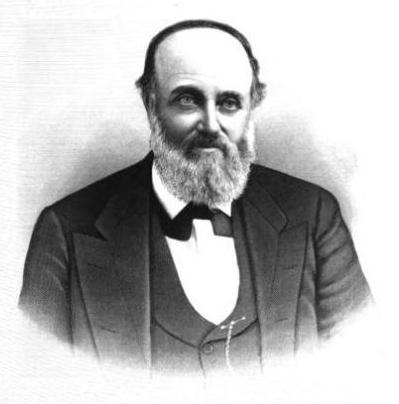
In that plat, Orange Avenue, as it was then named, is to the east of Jacobs Avenue, which is today Warren Avenue N. When I first saw this, I immediately thought of Orange Jacobs (1827–1914), associate, then chief justice of the territorial supreme court from 1869 to 1875, territorial delegate to Congress from 1875 to 1879, mayor of Seattle from 1879 to 1880, territorial councilman from 1885 to 1887, city attorney in 1890, and superior court judge from 1896 to 1900. 

I have no proof, of course, that Orange Avenue was named for Orange Jacobs — people rarely, if ever, documented why they gave particular names to streets in their subdivisions — but Jacobs and Latta were both Republicans and, more importantly, members of the same Masonic lodge, so for now I’m willing to put Jacobs down as the namesake of Orange Place N.

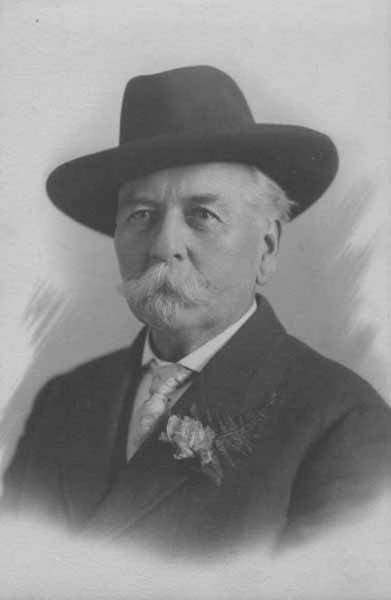
Orange Jacobs
Orange Jacobs

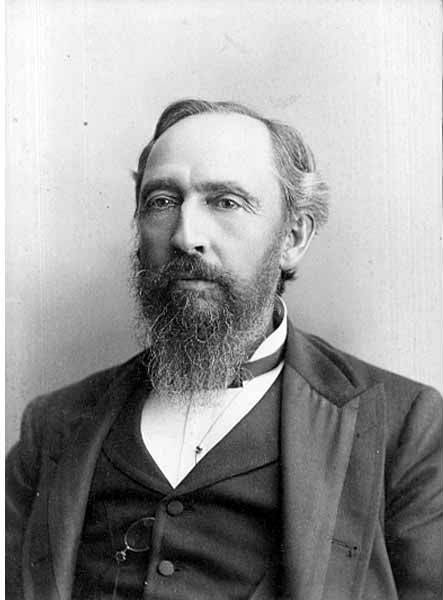
E Denny Blaine Place

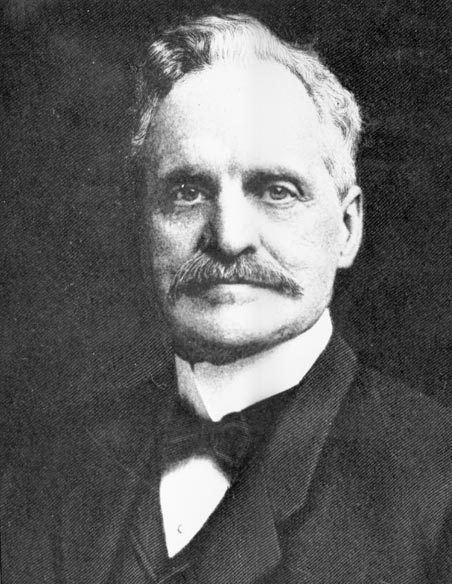
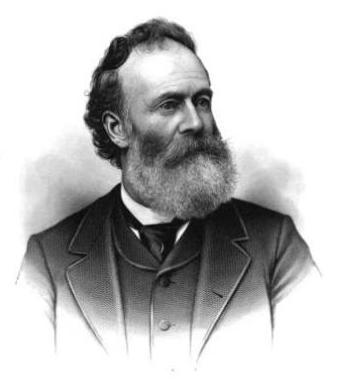
This short loop connects Lake Washington Boulevard E to 40th Avenue E and Denny Blaine Park on the Lake Washington waterfront. Street, park, and neighborhood — for the neighborhood is called Denny-Blaine too, though this time with a hyphen — are named for Charles Latimer Denny (1861–1919) and Elbert F. Blaine (1857–1942).

Denny was the youngest son of Arthur Armstrong Denny, leader of the Denny Party that landed at Alki Point in 1851; Blaine was a lawyer and parks commissioner from 1902 to 1908, and does not appear to be related to Catherine and David Blaine, after whom Blaine Street is named. Together, they operated the Denny-Blaine Land Company, and in 1901 filed the plat of Denny-Blaine-Lake Park to the City of Seattle (curiously, “Addition” seems to be missing before “to”). The street was originally named Whitman Place, and the park was unnamed; according to Seattle parks historian Don Sherwood, the street was renamed in 1918 to avoid confusion with Whitman Avenue N, and the park soon came to be known as Denny Blaine as well.

Incidentally, both portraits come from scans of newspapers; Blaine’s is from The Seattle Republican, September 27, 1912, and Denny’s is from the Seattle Post-Intelligencer, May 14, 1919 (his obituary). The original caption reads, in part:

The above photograph of Charles L. Denny was the last one he ever had taken. It was taken in the early nineties… and shows Mr. Denny, in the crude photography of that time, as he appeared when starting out on his successful business career.

Boren Avenue

This street was named for Carson Dobbins Boren (1824–1912), a member of the Denny Party that landed at Alki Point in November 1851. His sisters Mary Ann (1822–1910) and Louisa (1827–1916) married brothers Arthur (1822–1899) and David Denny (1832–1903) in 1843 and 1853, respectively. These weren’t the only Boren–Denny connections, either: his mother, Sarah Latimer Boren (1805–1888), who had been widowed in 1827, married John Denny (1793–1875) — Arthur and David’s father — in 1848. (Their mother, also named Sarah, had died in 1841.)

Boren is said to have built the first cabin in Seattle, at what is now 2nd Avenue and Cherry Street, in April 1852. He was elected King County’s first sheriff the same year. Boren’s land claim of 320 acres covered what is today a rectangle approximately bounded by (going clockwise) Yesler Way, 15th Avenue, E Cherry Street and its projection west, and Western Avenue and its projection north, but he sold it for $500 to Charles Terry and Edward Lander in 1855.*

* “Its projection” is necessary here because of Boren and Arthur Denny’s decision to have their street grid follow the shoreline, while “Doc” Maynard preferred his to follow the cardinal directions; Maynard’s grid eventually extended through the entire city and, indeed, county. (See “Seattle’s first streets.”) The actual southern boundary is a bit north of Yesler Way since both Boren and Maynard adjusted their initial claims to give Henry Yesler land to build and supply his sawmill.

Why Boren sold his land isn’t entirely clear. Sophie Frye Bass writes in Pig-Tail Days in Old Seattle that he sold it “early at a great sacrifice and became a roamer and, therefore, did not share in the up-building of the town”; her sister, Roberta Frye Watt, is indirectly quoted by Junius Rochester thus: “Carson had an unhappy home life. This compelled him to move deeper and deeper into the forest; to hunt and dream; and to shed most of his possessions.” Indeed, he and his wife, Mary Ann, divorced in 1861.

Carson Dobbins Boren, photographer and date unknown
Carson Dobbins Boren

Today, Boren Avenue S begins at 14th Avenue S, Rainier Avenue S, and S Jackson Street, and goes 2⅕ miles north to Valley Street and Lake Union Park, becoming Boren Avenue as it crosses Yesler Way and Boren Avenue N as it crosses Denny Way. It is one of the few north–south streets in Seattle to have three directional designations.

Stroud Avenue N

This street was named for Fred and Arabella Stroud, great-great-grandparents of my friend, local historian Rob Ketcherside. Writes Rob:

We no longer remember the exact circumstances that led to the naming. The fable is that Stroud earned the name by clearing the road, though. Originally one block long, the road was in Wood’s Green Lake Home Addition in 1892 (filed by later-mayor William Wood). Also in 1892 Fred worked for John Wallingford, whose daughter Emma was married to William Wood.

Today, Stroud Avenue N begins at E Green Lake Drive N and goes ¼ mile northeast, then north, to N 82nd Street.

Street sign, corner of Stroud Avenue N and N 80th Street, October 2010
Street sign, corner of Stroud Avenue N and N 80th Street, October 2010. Photograph by Flickr user Rob Ketcherside, licensed under Creative Commons Attribution-NonCommercial-ShareAlike 2.0 Generic.

Corliss Avenue N

Like Stone Way N, Corliss Avenue N is named for Corliss P. Stone (1838–1906), a member of the Seattle City Council from 1869 to 1872 and mayor of Seattle from 1872 to 1873, who was involved in the development of Fremont and Wallingford. 

Corliss P. Stone
Corliss P. Stone

Corliss Avenue N begins at N Northlake Way on the borth shore of Lake Union and goes nearly a mile north through Wallingford to the Good Shepherd Center just north of N 46th Street. There is another stretch from N 59th Street to N 65th Street in Green Lake. North of the lake, Corliss goes nearly another mile from East Green Lake Drive N to N 92nd Street and the North Seattle College campus. There are a few more segments through Haller Lake, the longest one being ¾ of a mile long from N 130th Street to the city limits at N 145th Street. As with other North Seattle avenues, the name continues on into Shoreline; its northernmost appearance is at N 194th Street.

Stone Way N

This street is named for Corliss P. Stone (1838–1906), a member of the Seattle City Council from 1869 to 1872 and mayor of Seattle from 1872 to 1873, who was involved in the development of Fremont and Wallingford. The standard story is that he embezzled $15,000 from his real estate development firm and abandoned his office — and the state — but the truth of the matter is unclear. He returned at some point to Seattle and helped found the Seattle Chamber of Commerce in 1882. His name also appears on Corliss Avenue N.

Corliss P. Stone
Corliss P. Stone

Stone Way N begins on the north shore of Lake Union at N Northlake Way and Waterway 22, and goes 1⅕ miles north to N 50th Street and Green Lake Way N. It forms an unofficial boundary between the Fremont and Wallingford neighborhoods.

Signs at corner of Burke-Gilman Trail and Stone Way N, August 24, 2009
Signs at corner of Burke-Gilman Trail and Stone Way N, just south of N 34th Street and north of N Northlake Way, August 24, 2009. Photograph by Benjamin Lukoff. Copyright © 2009 Benjamin Lukoff. All rights reserved.

Phinney Avenue N

This street is named for Guy Carleton Phinney (1851–1893), who was instrumental in the development of Fremont and Phinney Ridge. Woodland Park was once his private estate; in 1899, his widow, Nellie C. Wright Phinney (1867–1909) sold it to the city for $100,000. The animals of the Leschi Park menagerie were brought to Woodland Park in 1903 and combined with Phinney’s existing one to create what is now Woodland Park Zoo. Phinney Ridge is also named after him, as are the Carleton Park and Carleton Beach Tracts subdivisions in Magnolia, which were promoted by his sonArthur Alexander Phinney (1885–1941).

It has proved difficult to find a good photo of Phinney — this, the only one I could find online, is a group shot taken from a distance, so it’s hard to make him out — but I was able to find the below advertisement. His offer to refund the purchase price of “any lot, block, or acre” sold by him since 1881, with interest, is an impressive one — I wonder if anyone took him up on it? Ladd’s Addition later became part of Carleton Park; with the help of David Rumsey’s Georeferencer, I was able to determine that Governor Ferry’s blocks were located east of what is now W Viewmont Way W, between Parkmont Place W and W Raye Street.

Guy Carleton Phinney advertisement in the Seattle Post-Intelligencer, March 4, 1888
An advertisement by Phinney in the Seattle Post-Intelligencer, March 4, 1888

Phinney Avenue N begins at N 34th Street in Fremont and goes just over 2 miles north to N 70th Street on Phinney Ridge. Resuming at N 85th Street in Greenwood, it goes ¾ of a mile north to N 100th Street. There is another 1¼-mile stretch from N 105th Street to N 130th Street in Bitter Lake, and then a final two blocks between N 141st Street and the city limits at N 145th Street. As with many North Seattle avenues, the Phinney name continues on into Shoreline; its northernmost appearance is just south of N 200th Street.

Smith Street

This street is named for Dr. Henry A. Smith (1830–1915), after whom Smith Cove is also named. He and his family once owned most of what is now Interbay, between Smith Cove and Salmon Bay. He is likely best known today for his translation of Chief Seattle’s Speech. Though its authenticity has been questioned, it is accepted by the Suquamish Tribe and Duwamish Tribe, both of which siʔaɫ was chief.

Dr. Henry A. Smith
Dr. Henry A. Smith

Today, W Smith Street begins in Magnolia at the intersection of 37th Avenue W and 36th Avenue W and goes ⅘ of a mile east to just past 24th Avenue W, briefly becoming a stairway just west of 26th Avenue W at Ella Bailey Park. It begins again in Queen Anne at 7th Avenue W and goes ½ a mile east to Warren Avenue N, forming a portion of Queen Anne Boulevard between 1st Avenue W and Warren Avenue N. Smith Street’s final segment begins at 4th Avenue N and goes a block east, ending at a greenbelt overlooking Aurora Avenue N.

Mercer Street

This street is named for Thomas Dickerson Mercer (1813–1898), who came to Seattle in 1853 and homesteaded 160 acres in what is now Lower Queen Anne, living at what is now Roy Street and Taylor Avenue N. He became a King County commissioner and probate judge, and named Lake Washington and Lake Union, whose Lushootseed names are x̌ačuʔ and xáx̌əʔčuʔ (‘lake’ and its diminutive, respectively). Mercer Island is named for him, as are three of its main streets, W Mercer Way, N Mercer Way, and E Mercer Way. Mercer Slough in Bellevue is named for his brother Aaron (1826-1902), and his brother Asa (1839–1917) is known for being the first instructor at, and first president of, the Territorial University of Washington (being the only college graduate in Seattle in 1861); and for bringing the “Mercer Girls” to Seattle to address the settlement’s severe gender imbalance (thereby inspiring the 1960s TV show Here Come the Brides).

Thomas Mercer
Thomas Dickerson Mercer

Today, W Mercer Street begins at Elliott Avenue W and goes a block east to 6th Avenue W, where it becomes a stairway. At the top of the stairway, the street becomes a major arterial (connecting directly to Elliott via W Mercer Place) and goes 1⅔ miles east to Eastlake Avenue E and Lakeview Boulevard E, where it is blocked by Interstate 5. (It is, incidentally, laid out on the boundary between the donation land claims of Mercer and David Thomas Denny. Mercer’s claim is today bounded by Queen Anne Avenue N on the west, Lake Union on the east, Highland Drive on the north, and Mercer Street on the south.) Connecting Interbay, Lower Queen Anne, Seattle Center, State Route 99, South Lake Union, Interstate 5, and Capitol Hill, Mercer Street is a linchpin of Seattle’s transportation system — but not a beloved one, having earned the name “Mercer Mess” decades ago.

East of Interstate 5, E Mercer Street begins again at Melrose Avenue E and goes nearly 1½ miles to 28th Avenue E, interrupted only once, at 17th Avenue E, where it is pedestrian-only for half a block. Mercer resumes briefly at Dewey Place E but after a couple hundred feet becomes a stairway connecting to Lake Washington Boulevard E and 31st Avenue E. A block east of that, at 32nd Avenue E, E Mercer Street resumes as another stairway, and becomes a street again just west of 33rd Avenue E. This segment goes about ⅛ of a mile to 36th Avenue E. There is one final 200-foot-long segment of E Mercer Street east of 39th Avenue E. Platted into Lake Washington, this is a shoreline street end, but not, unfortunately, one open to the public. (It was this particular street end that first got me involved with Friends of Street Ends, as I grew up just ¼ of a mile up the hill.)

Street sign at corner of Lake Washington Boulevard E, 31st Avenue E, and E Mercer Street, October 11, 2009
Street sign at corner of Lake Washington Boulevard E, 31st Avenue E, and E Mercer Street. Both 31st and Mercer are pathways leading to stairways here, as noted by the🚶 icon. Photograph by Benjamin Lukoff, October 11, 2009. Copyright © 2009 Benjamin Lukoff. All rights reserved.

McGraw Street

This street is named for John Harte McGraw (1850–1910). In Pig-Tail Days in Old Seattle, Sophie Frye Bass writes of McGraw:

All in one year John McGraw was Chief of Police, Marshall, Sheriff, Harbor Master and Fire Warden. Later he was Governor of Washington and in between, bank president and attorney-at-law — quite a career.

The second governor of Washington after statehood (1893–1897), he had been King County sheriff during the anti-Chinese riots of 1886. He defended Chinese laborers from the mob that was trying to expel them from the city, although, according to The Role of Federal Military Forces in Domestic Disorders, 1877–1945, he initially sympathized with the rioters and allowed them to force the Chinese (without physically harming them) to the waterfront to be loaded onto the steamship Queen of the Pacific. Both he and Mayor Henry Yesler lost their bids for re-election that summer in what the book calls “a resounding show of support for anti-Chinese forces.”

John H. McGraw
John H. McGraw

Today, W McGraw Street begins as a shoreline street end on Elliott Bay in Magnolia west of Perkins Lane W. It begins in earnest at the intersection of Westmont Way W, Montavista Place W, and Rosemont Place W and goes ⅘ of a mile east to 24th Avenue W, forming the heart of Magnolia Village, the neighborhood’s commercial district, from 35th Avenue W to 32nd Avenue W. It resumes on the other side of Interbay in Queen Anne, beginning at 11th Avenue W and going 1⅛ miles east to the Northeast Queen Anne Greenbelt east of Bigelow Avenue N. There are a few block-long segments heading down the hill to Westlake and, like Blaine Street, a right-of-way platted into Lake Union that serves as a driveway and affords no actual lake access.

E McGraw Street doesn’t appear again until 15th Avenue E and Boyer Avenue E in Montlake, where it goes ⅔ of a mile east to 26th Avenue E at the west end of the Washington Park Arboretum, becoming a stairway for a short distance just before 19th Avenue E. It ends for good in Madison Park as a two-block stretch between 38th Avenue E and 40th Avenue E.

View looking south from the W McGraw street end: Elliott Bay, Puget Sound, and West Seattle
View looking southeast from the W McGraw street end: Elliott Bay, Puget Sound, and West Seattle, November 5, 2014. Photograph by Flickr user Seattle Parks and Recreation, licensed under Creative Commons Attribution 2.0 Generic

Blaine Street

This street is named for Catharine V. Paine Blaine (1829–1908) and her husband, David Edwards Blaine (1824–1900). Methodist missionaries from Seneca Falls, New York, where, in 1848, Catharine signed the Declaration of Sentiments at the first women’s rights convention, the Blaines came to Seattle in 1853 but left in 1856, not to return until their retirement from missionary work 26 years later. During their short initial stay in Seattle, however, they managed to build Seattle’s first church (the Little White Church, predecessor of today’s First United Methodist Church of Seattle), and Catharine became Seattle’s first schoolteacher, making $65 a month. Catharine Blaine School in Magnolia is named in her honor.

Catharine and David Blaine
Catharine and David Blaine at their 1853 wedding

Unfortunately, though the Blaines may have been feminists, they, according to HistoryLink.org, had no love for Native Americans (or, for that matter, the Irish). Their departure in 1856 was prompted by the Battle of Seattle. Junius Rochester writes:

On January 20, 1856, a son John, was born to Catharine and David Blaine. Six days later the Battle of Seattle erupted. David had duty at one of the blockhouses, but managed to get Catharine and their babe aboard the Decatur in Elliott Bay. David had described the Indians as a “poor degraded race,” which would “soon disappear.” Catharine compared their “stupidity and awkwardness” to that of the Irish. The Indian uprising confirmed their worst fears and prejudices.

Today, W Blaine Street begins in Magnolia at 36th Avenue W and goes a semicircular ⅕ of a mile to 34th Avenue W and W Howe Street. It resumes at 31st Avenue W and goes almost ⅓ of a mile to Thorndyke Avenue W. There is a stub of W Blaine east of 15th Avenue W that is quickly stopped by the Southwest Queen Anne Greenbelt. The street resumes at 12th Avenue W and goes just over a mile to 4th Avenue N, having briefly become a stairway at 9th Avenue W. After a series of short stretches serving as driveways and parking, the Blaine Street right-of-way resurfaces east of Westlake Avenue N and heads into Lake Union. Here, too, it serves as a driveway and offers no access to the water. East of Lake Union, E Blaine Street begins at Fairview Avenue E and goes ⅛ of a mile to Franklin Avenue E, where it becomes part of the I-5 Colonnade park underneath the freeway. From Lakeview Boulevard E to just west of 10th Avenue E it is a stairway, and then two blocks of roadway ending at 12th Avenue E and Lake View Cemetery. There is then a diagonal ¼-mile stretch from 19th Avenue E to E Howe Street in Montlake. E Blaine finishes up as a ⅕-mile stretch from 37th Avenue E to McGilvra Boulevard E and a final two-block run from E Madison Street to 43rd Avenue E, both in Madison Park.

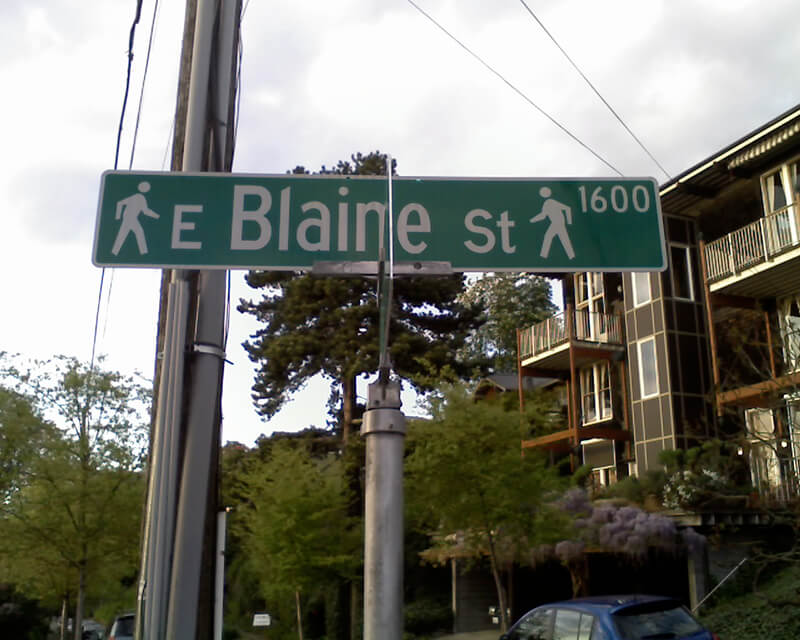
Sign for E Blaine Street, April 22, 2010
Sign for E Blaine Street at Broadway E, April 22, 2010. Blaine is a stairway on both sides of Broadway, hence the double 🚶 icon. Photograph by Benjamin Lukoff. Copyright © 2010 Benjamin Lukoff. All rights reserved.

Ward Street

This street is named for Dillis B. Ward (1838-1922). In Pig-Tail Days in Old Seattle, Sophie Frye Bass writes:

Dillis Ward, when a young man, did his part in building the old University for he drove a team that hauled stone and lime for the foundation. After the building was finished, he entered as a pupil into the first class. He taught school later on, and many an old-timer can recall the genial, kindly school teacher.

According to this biography, Ward, who came to Seattle in 1859, also had a hand in founding both The Post (a predecessor of the Seattle Post-Intelligencer) and The Seattle Daily Chronicle (a predecessor of The Seattle Times). However, his name does not appear in Professor Edmond S. Meany’s Newspapers of Washington Territory, in this article on the Post Building from the Pacific Coast Architecture Database, or in this HistoryLink article on the history of the P-I. All of them do mention brothers Kirk C. and Mark Ward, but Dillis’s entry at FamilySearch mentions no siblings, and Mark and Kirk’s entries do not mention Dillis. However, they do appear to have the same father, Jesse Ward. It looks as if Dillis was Jesse’s son from his first marriage, to Elizabeth Raley. As she died the same year Dillis was born, it may have been in childbirth. Kirk and Mark appear to be Jesse’s sons from his subsequent marriage to Exeline Cason. Exactly what part he may have played in the founding of the papers, and why this is missing from the articles above (and, incidentally, from Pig-Tail Days, which one would think might have mentioned this fact) is unclear.

Ward Street begins at Queen Anne Avenue N and goes ⅗ of a mile east to Aurora Avenue N. There is a short segment of E Ward Street on Capitol Hill between 14th Avenue E and 15th Avenue E, followed by another one, ⅓ of a mile long, from 23rd Avenue E and Turner Way E down the hill to 29th Avenue E and E Aloha Street, at the west end of Washington Park Playfield. There follows another one-block segment on the other side of the park, between 31st Avenue E and 32nd Avenue E, and a final segment from 34th Avenue E to 37th Avenue E.

Dillis B. Ward
Dillis B. Ward

Pontius Avenue N

This street — originally known as Lincoln when platted in 1875 by Rezin and Margaret Pontius (see Fairview Avenue N) — took the Pontius name as part of the Great Renaming of 1895, when the original Pontius (platted in 1880 by Margaret) became Melrose.

Margaret and Rezin W. Pontius and their children, Frank A., Lincoln H., Albert M., Mary, and Emma
This photograph is undated, but must have been taken before Rezin left the family around 1880. Margaret sued Rezin for divorce that year and he “fled to California,” not to return for many years.

Pontius Avenue N runs ⅓ of a mile from John Street north to just past Mercer Street, where it dead-ends at the Interstate 5–Mercer Street interchange (originally constructed in 1962–1963 as part of the planned Bay Freeway, which was cancelled 10 years later with little more progress having been made. Its original northern end was Roy Street.) Pontius originally began one block further south, at Denny Way, but this portion was vacated as part of the construction of the Denny Substation.*

* Or was it? The clerk file indicates the vacation was granted, but I can find no related ordinance, and the King County Parcel Viewer and quarter section map show the Pontius right-of-way still existing between Denny and John. Something for me to look into… sometime.

Bell Street

Bell Street originates in this 1870 plat filed by Arthur Armstrong Denny (1822–1899) and William Nathaniel Bell (1817–1887), both members of the Denny Party of settlers who arrived in what is now Seattle in 1851. Not only does Bell give his name to Bell Street and the Belltown neighborhood, but his daughters are honored by Olive Way and Virginia Street, and Olive’s husband by Stewart Street.

Today, Bell Street begins at Elliott Avenue and goes ⅗ of a mile northeast to Denny Way and 9th Avenue N.

William Nathaniel Bell

Lanham Place SW

Like SW Bataan Street, Lanham Place SW is part of High Point, originally developed by the Seattle Housing Authority in 1942 as defense housing and redeveloped in 2004. The name was originally applied to SW Lanham Way, and was preserved while some other names, including SW Snow Court, Cycle Lane SW, and MacArthur Court SW, were eliminated. It was named for Fritz G. Lanham, Texas congressman, who sponsored the Lanham Act that created the Defense Homes Corporation.

Today, Lanham Place SW begins at 32nd Avenue SW and SW Raymond Street and goes ¼ mile southeast to 31st Avenue SW, Sylvan Way SW, and SW Morgan Street.

E Remington Court

This street, which goes 600 feet from 12th Avenue in the west to 14th Avenue in the east, a block south of E Jefferson Street, was named as part of Greene’s Replat of Block 10, Squire Park Addition to the City of Seattle in 1903 by William Kimball Greene (1869–1940), transferring the Remington name a block south from Jefferson, the street it was originally applied to in 1890 by Watson Carvosso Squire (1838–1926), who had been territorial governor of Washington from 1884 to 1887 and Washington’s senator from statehood in 1889 to 1897.

Squire married Ida Remington in 1868; the next year, William Kimball Greene was born to Ida’s younger sister, Catherine, and her husband, Elijah Priest Greene. Ida and Catherine’s father, Philo, was the son of Eliphalet, who in 1816 had founded what became E. Remington and Sons, predecessor of Remington Arms and, via Remington Typewriter Company, Remington Rand and its successor, IT company Unisys.

Because Squire was the first to apply the name to a street, I count E Remington Court as ultimately being named after his wife, Ida, though one could say Greene’s preservation of the name, after the E Jefferson Street name had been extended by ordinance in 1895 from First Hill to Lake Washington, might also have been to honor his mother, Catherine.

Watson C. Squire and his wife, Ida Remington, circa 1910.
Watson Carvosso Squire and his wife, Ida Remington, circa 1910

Covello Drive S

This hook-shaped street on Beacon Hill begins where S Myrtle Street turns into Swift Avenue S, and goes just over 700 feet north, west, and then south to a point 300 feet to the northwest. It was created in 1967 as the only street in the plat of Covello Estates, filed by S.T. Covello, whose full name appears to be Salvatore Tony Covello (1913–1996). He was the son of Filippo and Josephine (Curreri) Covello, who came to the United States from Italy in 1908. An article in the September 25, 1946, Seattle Times mentions him as the owner of the Hillman City Radio and Electric Company, and one in the March 4, 1956, Times lists him as a candidate for the King County Board of Education.


McGilvra Boulevard E

This street, which appears to have been established as part of the 1906 Replat of McGilvra’s Addition and Second Addition to the City of Seattle (an abbreviation of its much longer name), was named for John J. McGilvra (1827–1903). Born in Livingston County, New York, McGilvra moved to Illinois at the age of 17, and became a lawyer nine years later. In 1861, President Abraham Lincoln, who McGilvra reportedly knew as a fellow Illinois lawyer, appointed him United States Attorney for the Territory of Washington. In 1864, he moved to Seattle. That same year, he and his wife, Elizabeth, bought 420 acres of land in what is now Madison Park and became the area’s first settlers. McGilvra had Madison Street extended to the lakefront — it is still the only street to extend from Elliott Bay to Lake Washington without interruption — and later helped establish the Madison Street Cable Railway Company and Madison Park at its eastern terminus. In 1865 he relinquished the post of U.S. attorney. He was a member of the Territorial Legislature in 1866 and 1867, and Seattle city attorney in 1876 and 1877. He retired in 1890.

John J. McGilvra, circa 1890

Today, McGilvra Boulevard E begins in the south at 39th Avenue E and Lake Washington Boulevard E and goes 1⅖ miles north to E McGilvra Street. Unlike most other boulevards in the city, it is not an Olmsted boulevard — McGilvra was reportedly opposed to the movement that resulted in the hiring of the Olmsted Brothers in 1903 (the year of his death) to design a system of parks and boulevards for Seattle, though there is no evidence the two are directly related.

Knox Place E

This street in Madison Park — one I remember from childhood, as I was interested in maps and streets even then, and this one wasn’t part of the regular grid — is essentially a driveway for three houses. Only 100 feet long, it hangs off E Lee Street between 42nd Avenue E and the Lake Washington shoreline like an afterthought, which indeed it was, appearing neither on the 1875 plat of John J. McGilvra’s 2nd Addition to the City of Seattle nor the 1908 Board of State Land Commissioners’ Map of Lake Washington Harbor. The first reference to it in The Seattle Times is in 1925. I couldn’t find an ordinance establishing it, but I did find Ordinance 63622, passed in 1933:

An ordinance accepting deeds from Hubert W. Youngs and Maude E. Youngs, husband and wife, Harry Richmond, William G. Knox, and Bessie S. Woodworth, for an easement for sewer over and across a portion of J. J. McGilvra’s 2nd Addition and Lake Washington Shore Lands.

Since Knox Place is very close to where the two plats meet, I figure it’s a good bet that William G. Knox has something to do with Knox Place. FamilySearch says a William Gifford Knox (1884–1964) lived in Seattle for a time, and even had a scan of his draft registration card for World War I, from September 12, 1918. He appears to have been a salesman for the Dennison Manufacturing Company downtown, and his address is given as 1836 Laurel Shade Avenue. That street is now 43rd Avenue E, putting his residence just a few blocks north of Knox Place E. So, although I don’t have the whole story, I think we now know who Knox Place is named for.

William Gifford Knox World War I Draft Registration Card, 1918
William Gifford Knox draft registration card for World War I, September 12, 1918

NE Kelden Place

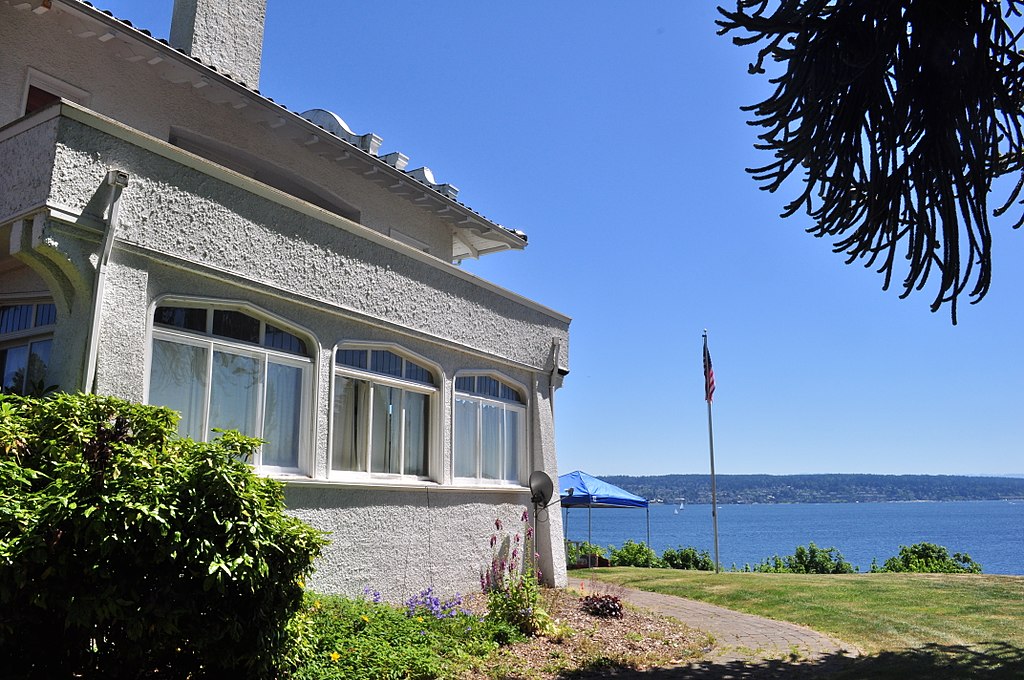
This short street in Seattle’s Windermere neighborhood runs from 60th Avenue NE and NE 55th Street in the southwest to 63rd Avenue NE and NE 57th Street in the northeast. It was likely named after Lochkelden, the mansion built in 1907 for Rolland Herschel Denny (1851–1939) and his wife, Alice Martha Kellogg Denny (1857–1940). Rolland was just six weeks old when the Denny Party landed at Alki Point in November 1851. Lochkelden — owned since 1974 by Sun Myung Moon’s Unification Church — was itself named for Lake Washington, of which it has a commanding view (loch being Scottish for ‘lake’) and its owners: Kellogg and Denny.

Note added March 14, 2024: It appears, per Clay Eals at PaulDorpat.com, that the church put Lockhelden on the market in 2022 and it just sold for $6 million. The purchasers are developers, and property owned by religious organizations cannot get landmark protection against the owner’s will, so the mansion’s days are almost certainly numbered.

Note added December 18, 2024: Jean Sherrard just posted a video of Lockhelden being demolished.

South façade of Lochkelden, June 24, 2017
South façade of Lochkelden, June 24, 2017. Photograph by Joe Mabel, Wikimedia Commons, licensed under Creative Commons Attribution 4.0 International